



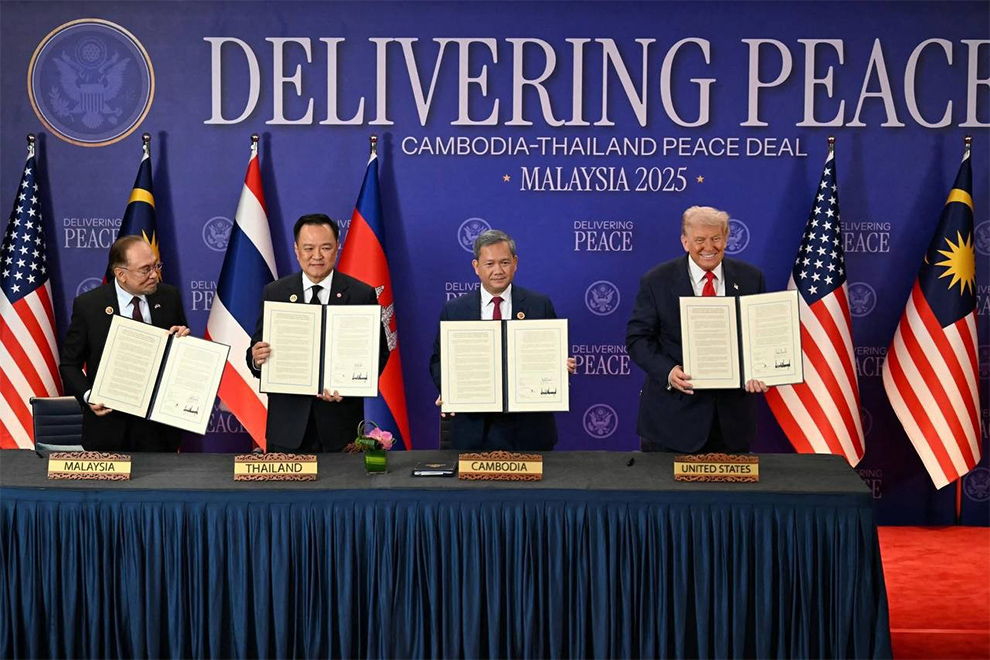
As ASEAN leaders gather in Kuala Lumpur from 26-28 October 26-28, under Malaysia’s chairmanship, the regional bloc faces a defining question: Has its own institutional weakness made it increasingly vulnerable to great-power manipulation?
The summit’s theme, “Inclusivity and Sustainability” is meant to inspire confidence, yet ASEAN’s inability to manage internal conflicts from the Cambodia-Thailand border dispute to the continuing crisis in Myanmar reveals the opposite. If ASEAN were institutionally strong enough to resolve its own problems, it would not be forced into reactive choices between the US and China, or between symbolic engagement and strategic independence.
The “ASEAN Way”, grounded in consensus, consultation and non-interference, was once a stabilising formula, but today it has become a structural limitation. Consensus too easily leads to paralysis. When the bloc cannot act collectively, external powers fill the vacuum. The Cambodia-Thailand conflict and the failure to enforce the Five-Point Consensus on Myanmar expose this fragility.
If Thailand had respected ASEAN’s dispute-resolution mechanisms instead of relying solely on bilateral gestures, and if ASEAN had empowered its own High Council under the Treaty of Amity and Cooperation, the region would have shown strategic maturity. Instead, indecision has invited outside influence and blurred ASEAN’s autonomy.
During his first term, President Donald Trump showed little interest in ASEAN. He attended only one summit, the 2017 meeting in Manila hosted by the Philippines and then skipped every gathering after that until 2021. He also left the post of US ambassador to ASEAN vacant for most of his term and treated regional diplomacy as little more than transactional politics.
Yet his recent symbolic praise for the Cambodia-Thailand peace deal is being framed by some as support for ASEAN diplomacy. It is, in truth, opportunistic theatre: an attempt to project US influence while ASEAN’s own mechanisms stand idle. If ASEAN had resolved its border tensions through its institutional framework, Trump’s gestures would have carried little meaning. Instead, his rhetoric highlights how easily ASEAN neutrality can be jeopardised by external personalities exploiting internal weakness.
The Kuala Lumpur Summit has also been overshadowed by the absence of Chinese President Xi Jinping, who has traditionally attended ASEAN meetings at the highest level. While Beijing cited scheduling constraints, Xi’s non-attendance inevitably raises questions about ASEAN’s convening power. Without China’s top leadership present, the summit’s symbolism appears diminished especially when other regional figures such as Indian Prime Minister Narendra Modi also stayed away, giving higher priority to non-ASEAN platforms like APEC and the Quad.
Such absences reflect a broader shift: ASEAN centrality is being quietly eroded as major players increasingly favour alternative forums they consider more strategic and result oriented.
Malaysia, under Prime Minister Anwar Ibrahim, has pledged to restore balance by promoting engagement with all major powers, but rhetoric alone cannot restore credibility. ASEAN needs institutional reform, strengthening its Secretariat, granting it greater authority to mediate disputes and re-examining the consensus rule that too often rewards inaction. Without such change, ASEAN will continue to drift, reactive to the ambitions of others rather than responsive to the needs of its own members.
If ASEAN had possessed the capacity to handle the Cambodia-Thailand border issue and the Myanmar crisis effectively, it would not now be navigating between Beijing and Washington or depending on Trump’s symbolic overtures. The problem is not a lack of principle but a lack of institutional power. Xi Jinping’s and Modi’s absence, alongside Trump’s performative diplomacy, all illustrate how the region’s most important platform risks becoming secondary to external agendas.
To “honour Trump” or to “isolate China” is to misread the lessons of ASEAN’s past. Neutrality, inclusivity, and self-reliance are not outdated ideals; they are the only viable strategy for regional stability. The Kuala Lumpur Summit must therefore remind the world that ASEAN’s true strength lies not in personalities, but in principles.
Seng Vanly is a Phnom Penh-based geopolitical analyst. The views and opinions expressed are his own.
