Thailand has moved swiftly to escalate its confrontation with Cambodia.
In one sweep, Bangkok has announced a referendum to revoke the 2000 and 2001 border memoranda of understandings (MoUs), floated indefinite closures of crossings, advanced plans for a high-tech border fence, invoked allegations of Chinese arms entering Cambodia, reshuffled military command along the frontier and now pressed for the evacuation of Cambodian civilians from villages on contested ground as a condition for further talks.
None of these actions are isolated episodes. They form a sequence designed to squeeze Cambodia on every axis: legal, diplomatic, humanitarian and military. The question is whether these manoeuvres stand on solid ground or whether they risk tipping the dispute into renewed instability.
Thai Prime Minister Anutin Charnvirakul’s promise of a referendum on the MoUs is meant to transform escalation into an expression of popular will. Yet MoUs are bilateral instruments.
They cannot be erased by one side’s domestic process. Cambodia’s foreign ministry has already reaffirmed the MoUs as binding, warning that unilateral withdrawal would violate international law. Thai legal experts themselves have raised doubts over whether such a referendum would be constitutional or enforceable. What exists today is an announced intention, not a scheduled vote. That gap between political theatre and treaty reality is Bangkok’s first fracture.
The Thai National Security Council’s (NSC) approval of a high-tech fence and talk of indefinite closure suggest permanence rather than temporary leverage. But the Thai economy depends heavily on border trade, migrant labour and ecosystems built over decades. To weaponise closure risks cutting both ways. The image of control may win headlines in Bangkok, but the practical costs to traders, workers and border families will quickly surface. Humanitarian fallout will move faster than diplomatic communiqués.
Perhaps the sharpest escalation is the NSC investigation into alleged Chinese arms entering Cambodia. If endorsed, this reframes a bilateral dispute into a regional security confrontation. For Bangkok, it positions its stance not as aggression but as frontier defence against Chinese encroachment. For Phnom Penh, it pulls China, its closest partner, into the centre of the narrative, complicating its legal and diplomatic positioning.
The Chinese embassy in Bangkok has already publicly denied any arms transfers. Even if evidence remains thin, the rhetorical effect primes foreign capitals to view Cambodia through a security lens.
Changes in border command add weight to these signals. Rotations of generals in charge of posture and engagement rules rarely occur without purpose. They suggest preparation for sustained pressure or tighter control of troops. Combined with the NSC’s framing, the message is that Thailand is aligning both political and military instruments for a prolonged confrontation.
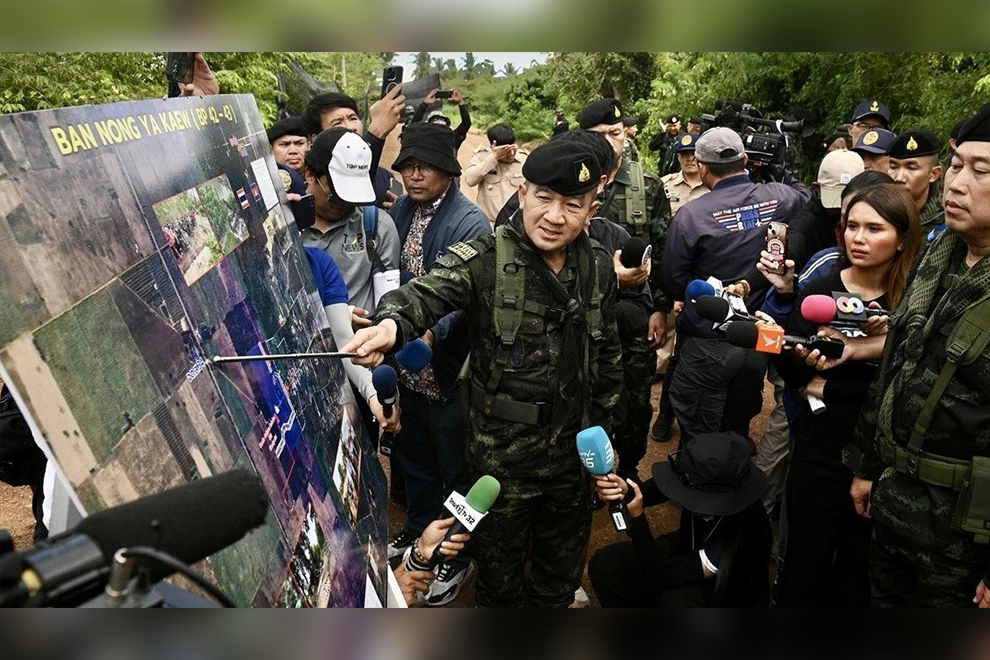
The newest move is the First Army’s demand that Cambodian residents in Ban Nong Chan and Ban Nong Ya Kaew be evacuated, or else the upcoming Regional Border Committee meeting in Banteay Meanchey be postponed.
Roughly 200 families are directly affected. By pressing for evacuation to be added to the agenda, Bangkok projects moral authority while altering the frame of talks. If Cambodia resists, Thailand can cast Phnom Penh as ignoring the safety of civilians. If Cambodia accepts, it risks appearing to concede Thai jurisdiction over Cambodian citizens in contested areas.
More dangerously, humanitarian language becomes weaponised. The discourse shifts from maps and treaties to who controls movement and protection. That terrain is harder to manage, and once internationalised, it invites scrutiny from ASEAN, UN agencies and rights monitors.
It also risks forcing civilians into the role of bargaining chips, with their agency absent while their fate is negotiated across tables.
Phnom Penh’s responses so far have been muted, but silence may be calculation rather than weakness. Cambodia can counter by proposing joint civilian protection protocols or inviting observers to show proactive commitment rather than obstruction.
The upcoming RBC meetings on Cambodian soil, scheduled for October 10 to 12, will test whether Thailand’s rhetoric translates into willingness to sit across the table. That timing is not accidental. Bangkok stacked its referendum announcement, fence plan and evacuation demand in the run-up to RBC talks and just ahead of Cambodia’s Pchum Ben festival, when domestic attention is divided.
The international stakes are high. ASEAN has mediated before, and Malaysia has brokered ceasefires. China cannot remain a bystander if its name is invoked in arms allegations. Western governments will monitor both legal breaches and humanitarian fallout.
The central concern is that revoking or bypassing the MoUs without replacement creates a vacuum, no common maps, no joint procedures, only unilateral claims. History shows that such vacuums invite clashes, as seen at Preah Vihear when absence of agreed scaffolding turned disputed terrain into live battlefields.
Thailand’s sequence is deliberate: referendum, fence, closure, China framing, command shifts, evacuation demand.
It is timed to precede the RBC talks, ensuring Cambodia’s negotiators sit under layered pressure.
Yet the gamble is double-edged. If Cambodia responds with discipline in law and diplomacy, it can hold credibility internationally. If both sides escalate in rhetoric, the spiral tightens. For ASEAN, the UN, and global observers, this is no longer just a border dispute. It is about precedent: whether a state can discard binding agreements by popular vote, invoke humanitarianism to dictate talks and recast a neighbour’s sovereignty under the shadow of China.
The next 72 hours, the NSC report, the RBC outcome and international responses will determine whether this dispute sharpens into confrontation or is contained within law. Votes can make noise. Fences can be built. Evacuations can be demanded. But borders are made by agreements.
Ponley Reth is a Cambodian writer and commentator based in Phnom Penh. The views and opinions expressed are his own.