



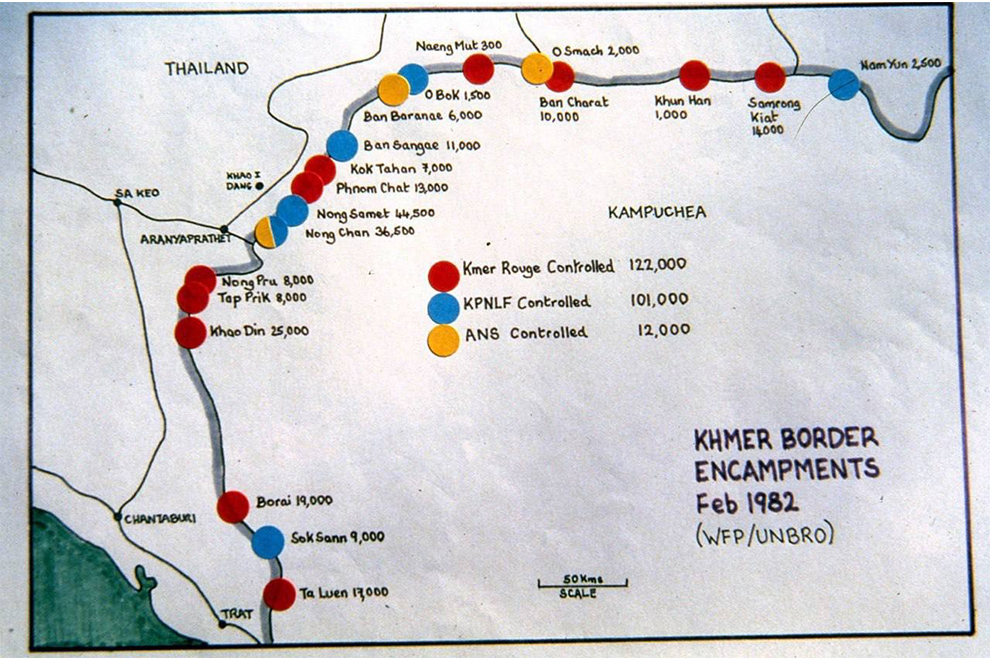
Dear readers, I wish to provide clarification and enlightenment in response to an August 19 article in The Nation Thailand, which stated that Thailand “provided sanctuary for Cambodian refugees” in the late 1970s and 1980s. I wish to shed on the true history of the refugee camps along the Thai–Cambodian border for the Thai people.
After the fall of Democratic Kampuchea (the Khmer Rouge) in January 1979, many Cambodians fled their homeland and sought shelter near the border Thai – Cambodia border. One makeshift settlement was called Chom Rom Chass.
On June 8, 1979, the Thai military deceived the refugees with promises of resettlement in third countries.
Instead, they transported several thousand refugees from Chhom Rom Chass to the border near Preah Vihear temple, where the refugees were forcibly repatriated into a minefield.
Many who tried to return were shot dead by Thai soldiers, while countless others fell victim to landmines or plunged from the steep cliff faces on what is now called Ghost Mountain.
Later, Thailand built another large dam behind Chom Rom Chass, near Kork Kchoung. In late August, Kong Sileah, a former naval officer, established a resistance force stationed near Kork Kchoung not far from Chom Rom Chass.
On November 8 – after a Thai soldier accused of raping a Khmer woman was killed – Thai military commander Colonel Prachak Sawaengchit ordered his troops to shell the refugee camp at Kork Kchoung (known then as Camp 511), as well as Chom Rom Chass, which resulted in the deaths of around 100 refugees.
The incident drew international attention, as US First Lady Rosalynn Carter was scheduled to visit Sa Kaeo Refugee Camp the following day.
Chom Rom Chass was burned down by the Thai army later that month. The refugees formed the Nong Chan Camp.
In late November, Kong Sileah moved his forces to a camp at Prey Preah Pnov where he built a fortress near Nong Chan.
While there, he met Robert Patrick Ashe, an English humanitarian. It was decided that food distribution should take place at Nong Chan refugee camp, enabling Cambodians to carry food and agricultural supplies back into Cambodia, as part of what became known as the Landbridge project.
Nong Chan camp, as well as Ang Sila, Prey Chan and O’Bei Choan, were in fact, on Cambodian territory — although the Thais dug dams and canals far behind Nong Chan Camp to mark boundary line to prevent the refugees and Vietnamese troops from entering the Thai soil.
Under pressure from the international community, the UN established the UN Border Relief Operation (UNBRO) to aid Cambodian refugees.
Many surviving Cambodian refugees and the international aid workers from UNHCR, UNBRO, ICRC, CRS, COERR, MSF, CARE, OXFAM and UNICEF, as well as journalists, are still alive today and could testify about these events and the border between the two countries.
It is crucial to remember that it was international pressure, not Thai benevolence, that led to the semi-permanent establishment of the refugee camps.
Therefore, I urge the Thai government and people to reconsider their claims that Thailand was “helping” Cambodian refugees out of the goodness of their own hearts. In truth, it was the UN and the international community who pressured and funded Thailand, channelling millions of US dollars in humanitarian relief.
Meanwhile, the Thai government profited by selling goods and services to UNBRO operations.
With this in mind, it is clear that Cambodia owes Thailand nothing.
Furthermore, the question must be asked. If those lands truly belonged to Thailand, why didn’t the Thai government bring this issue to the UN or IJC? They had decades to do so after the camps closed, but chose not to. The timing around the latest claims, coming as they do during the period of heightened nationalism that followed the recent border clashes, has raised suspicions among many commentators.
Finally, a warning. If our neighbours continue to encroach upon our land, we Cambodians have no choice but to defend ourselves. We do not seek conflict, but believe in peace and international law. History cannot be erased. The truth will always prevail.
Respectfully,
Tesh Chanthorn
Tesh Chanthorn is a concerned Cambodian citizen who wishes for peace, and for the world to know the truth about the recent border clashes. The views and opinions expressed are his own.
