



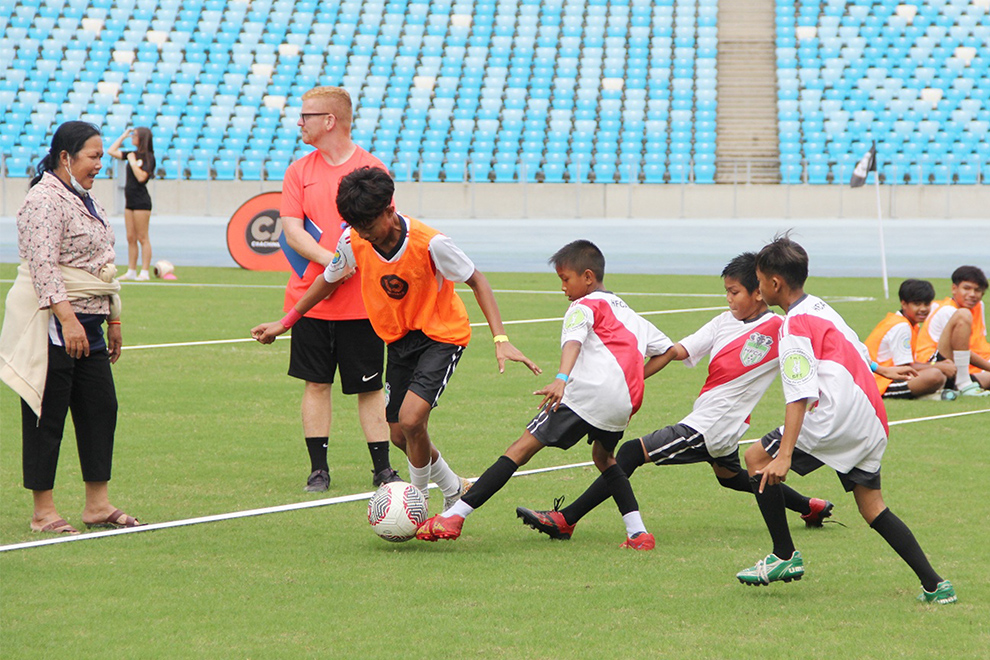
The Happy Football Cambodia Australia (HFCA) organisation and its partners celebrated their 20th anniversary at the Morodok Techo National Stadium on Sunday, November 16. Many of the vulnerable children who have received training from HFCA joined the event, along with several distinguished guests, all of them taking part in a series of friendly football matches to mark the occasion.
HFCA founder Paraic Grogan described the 20th-anniversary celebration as a special moment, which showcased the organisation and its partner’s successful efforts to ensure that disadvantaged youth in Cambodia have access to high-quality football training. More importantly, he noted, HFCA provides a pathway for young people to further develop soft skills that will help them succeed in education and future employment.
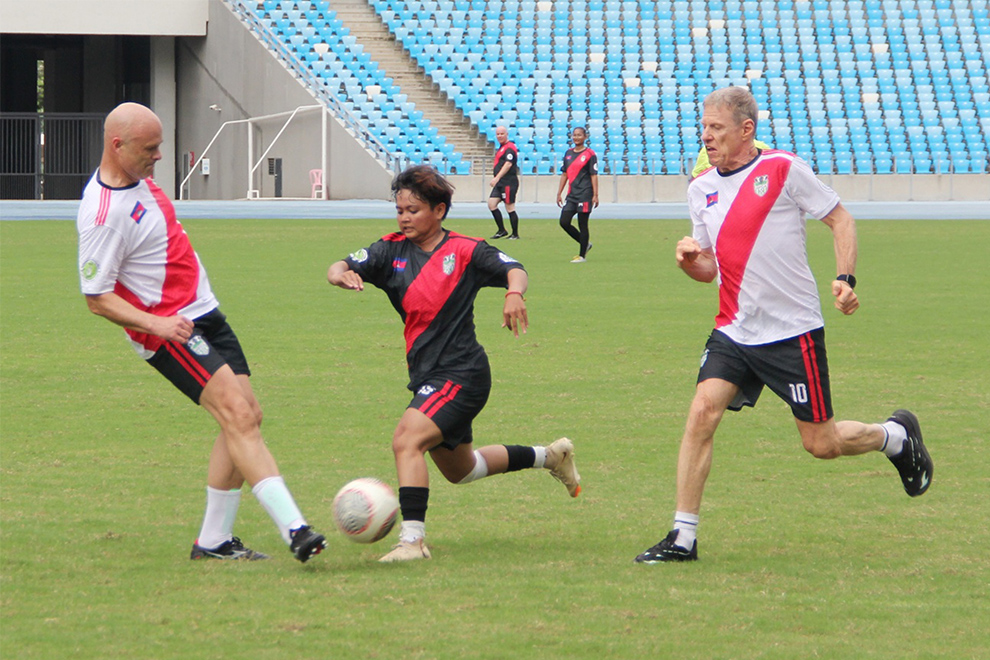
“It was a tournament involving 32 children from Phnom Penh and 32 from Siem Reap at our beautiful national stadium, guided by professional coaches. We also had a VIP match with our special guests, to celebrate HFCA’s 20 years of working with our partners to support poor children in Cambodia through football,” he said.
For the past 20 years, HFCA has partnered with Scott Neeson, founder of the Cambodia Children’s Fund, to provide kids in Phnom Penh with opportunities to play and train in football. HFCA also works with Long Setha, founder and director of Build Your Future Today (BFT), to organise training and football activities for disadvantaged children in Siem Reap.
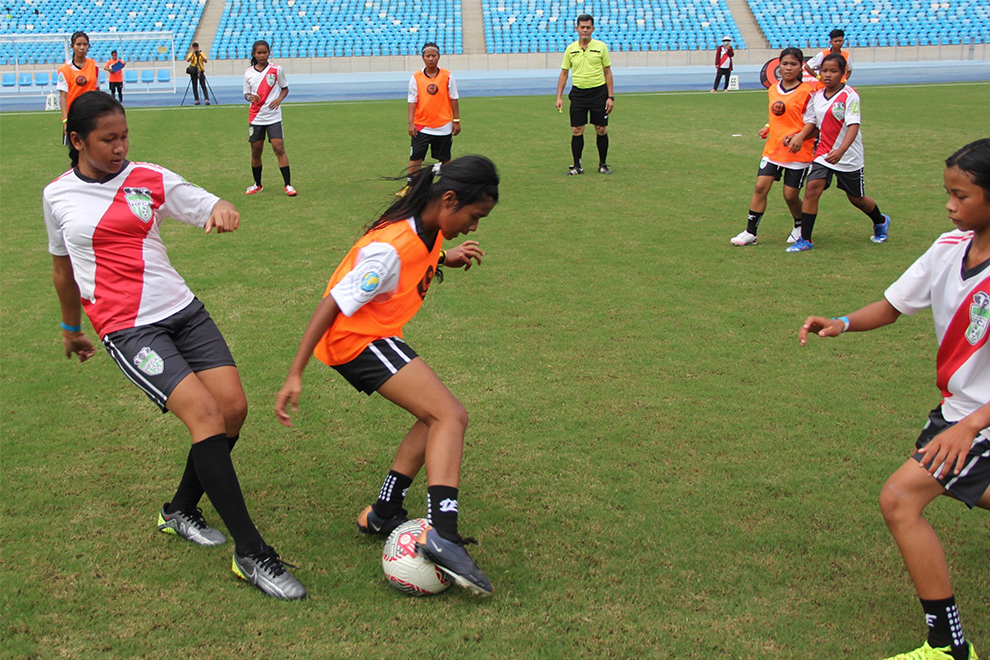
Neeson, Setha and other partners — including former athletes who once trained under HFCA — all joined the 20-year anniversary event and participated in the football activities. Meanwhile, the 64 children from Phnom Penh and Siem Reap played age- and gender-grouped matches organized by CJ Coaching.
“Our children enjoyed the competition very much, especially those from Siem Reap who had their first chance to visit Phnom Penh and play at the Morodok Techo National Stadium. We also took them to visit the Royal Palace and several other places, giving them a memorable and joyful experience,” explained Grogan.
Chhim Meyly, a grade 7 student from Siem Reap, expressed her excitement at visiting Phnom Penh for the first time. She was also amazed to have the opportunity to play football on the national stadium’s pitch.
“I train and play regularly in Siem Reap, but I never imagined I would come to Phnom Penh and play at the Morodok Techo National Stadium. It is so beautiful — I have never seen anything like it,” she said.
“Even though my team lost to the Phnom Penh team because they are stronger, I am not discouraged. I will keep training hard so I can win next time. I won’t stop playing football — I want to continue until I grow up. I dream not only of playing for a club, but also for the national team one day,” she added.
Nan Rot, a 13-year-old boy from Siem Reap, also shared his thoughts.
“I am very happy because I have never played on such a beautiful pitch. Today’s experience makes me even more determined to play football. Even though I’m small, I want to become a skilled player who can play for a club. I will work hard to reach that goal,” he said.
Inspired by the smiles and dreams of the disadvantaged children, Grogan expressed his determination to help even more vulnerable families so their children can have the same opportunities. Through football, HFCA has selected many children for advanced training and sent them abroad to compete — notably in the Homeless World Cup — to give them real-life experience and exposure to the outside world.
“Over the past 20 years, we have worked with 5,000 young men and women from poor families in Phnom Penh and Siem Reap. We have sent teams to international competitions 14 times — in the US, North America, South America, Australia, Europe, and several Asian countries,” he said.
Looking beyond HFCA’s achievements over the past two decades, Grogan announced even bigger goals to help more disadvantaged children gain access to football as a tool for self-development and future employment. But he also called for continued support from existing partners and new sponsors.
“In the next 5 to 10 years, we want to work with even more disadvantaged children — not just 5,000, but 10,000. I want poor children in Phnom Penh, Siem Reap and provinces across Cambodia to have the opportunity to play football and use this skill to build confidence, strengthen their abilities and succeed in life,” he said.
