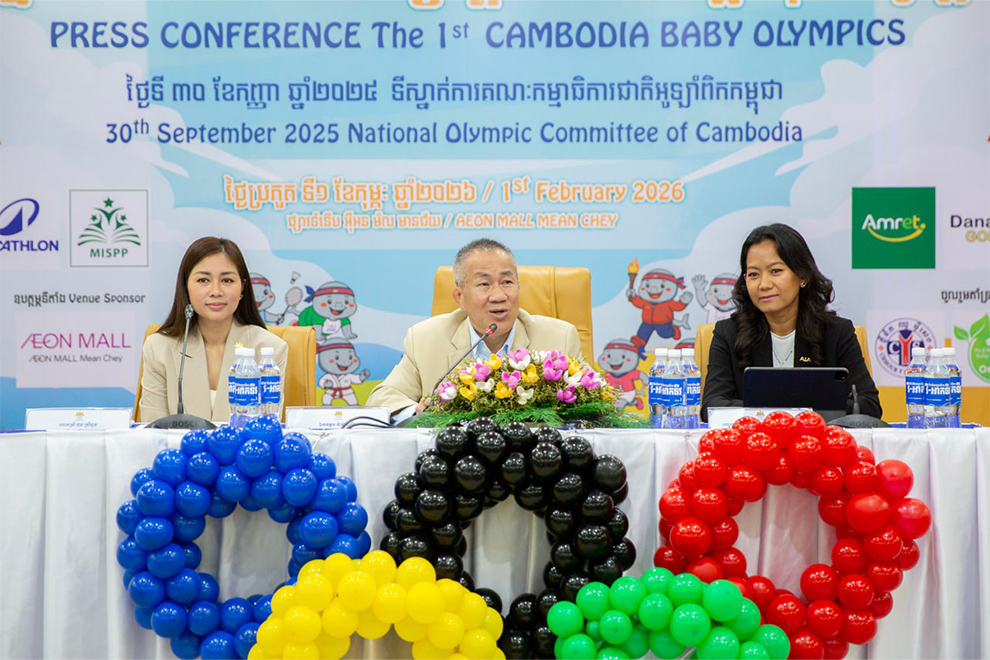
The National Olympic Committee of Cambodia (NOCC) has formally announced the first-ever “Cambodian Baby Olympics”. The event, for one- to six-year-olds, will take place at AEON Mall 3 on February 1, 2026.
The new initiative aims to promote and educate the public about Olympic values and also serve as a pathway for training the next generation of elite athletes who could one day win Olympic gold for Cambodia.
During a September 30 press conference, NOCC secretary-general Vath Chamroeun explained that the Baby Olympic Games are a new initiative promoted by the International Olympic Movement. The goal is to spread and instil Olympic values in children, so they learn about respect, good relationships, determination and self-discipline from an early age.
“We must cultivate Olympic values starting from childhood. This is why, under the guidance of NOCC president Thong Khon, we aim to make this event an important national movement starting next year. Our campaign begins now,” he said.
The event has three main objectives.
It will instil Olympic values from childhood.
Chamroeun hopes that the children participating — and even winning — at this event could one day become Olympic athletes and potentially earn medals for Cambodia in the future.
“We may not realise it now, but 20 to 30 years from today, one of these children who wins at the Baby Olympic could become an Olympic medallist. This is our vision — a long-term path to success in life,” he said.
It will also introduce children to competitive games.
The second objective is to help children understand what competitions and games are like, creating long-term memories that encourage continued participation. Cambodia also plans to organise international Baby Olympic events and attend the World Baby Olympics in the future.
“For now, we start at the national level, but the goal is to reach the International Baby Olympics. We plan to invite children from China, Japan and other countries to compete with Cambodian children. We aim to organise friendship-based regional competitions, then expand to Asia and eventually the World Baby Olympics. This is not a spontaneous idea — we have a clear plan and direction,” Chamroeun noted.
It will give children aged one- to six-years-old the opportunity to play sports.
The third aim is to introduce sports to more children and help their parents or guardians understand the benefits of sports.
“We all know sports are part of daily life. At the very least, we must walk, run and exercise. We encourage children starting from early childhood and help parents and society recognise sports as essential for education and improving children’s quality of life,” added Chamroeun.
The NOCC aims to register around 500 children for the first games, to ensure manageable organisation. The committee and its partners are committed to staging the event based on the standards and spirit of the Olympic Games.
“We are organising the event to resemble the Olympic Games. There will be children carrying the torch, singing, dancing, cultural performances, and full opening and closing ceremonies with fireworks — just like the real Olympics,” explained Chamroeun.
However, he clarified that the one-day event in 2026 is not focused on winning or losing.
“This is about participation, fun and making the decisions to play sport, helping us build a new generation of elite athletes who can win Olympic titles,” he noted.
“The Baby Olympic movement is gaining momentum in other countries too, and soon there will be a World Baby Olympics. So, we are developing our future Olympic champions starting now. When we host the Baby Olympic Games annually from 2026 onward, Cambodia could eventually have the opportunity to host the World Baby Olympics as well,” he added.