Russia and Cambodia have expressed their readiness to support one another in strengthening cooperation in the Olympic and Paralympic movements, as well as for other sporting diplomacy on the international stage. Russia is also prepared to provide scholarships for Cambodian sports students to pursue study and professional sports training in Russia, aimed at further advancing Cambodia’s sports sector.
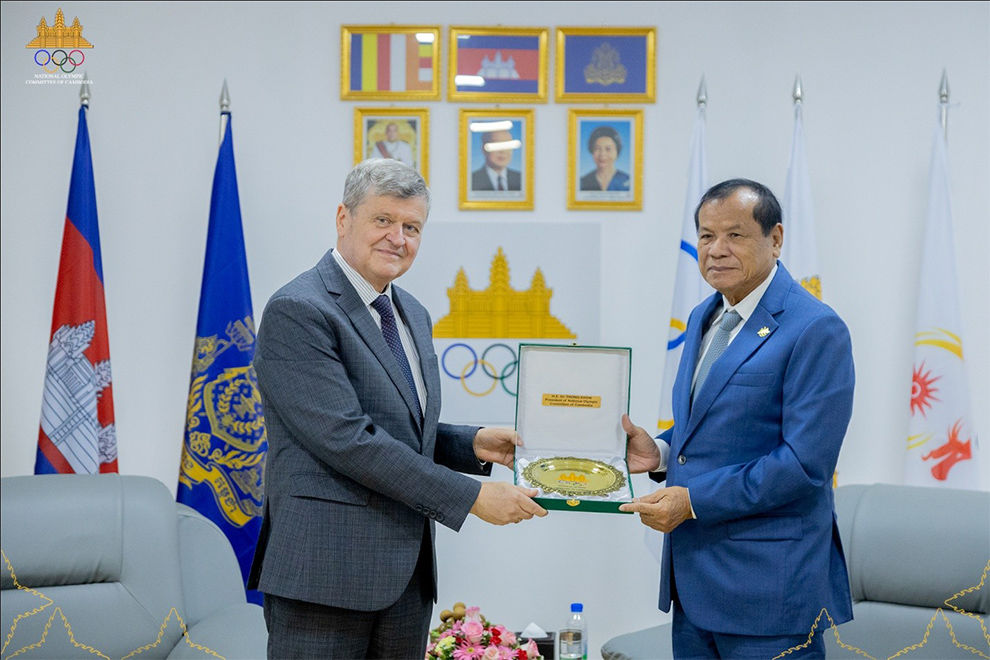
Senior Minister Thong Khon, president of the National Olympic Committee of Cambodia (NOCC) met with Russian ambassador Annatoly Borovik on September 10 at the NOCC headquarters.
Vath Chamroeun, NOCC secretary-general, explained that their important discussions focused on cooperation in both the Olympic and Paralympic movements, along with mutual support in sports diplomacy efforts.
During the talks, Borovik highlighted Cambodia’s participation in the Eastern Economic Forum – Sport Diplomacy conference, held in Vladivostok, Russia, from September 3–6, where Chamroeun represented both the Ministry of Education, Youth and Sport and the NOCC.
The ambassador informed Khon that Russia is ready to support Cambodian sports students with scholarships for training and higher education in sports science and professional sports skills development, thereby contributing to human resource capacity-building in Cambodia’s sports sector.
“What the ambassador underlined is that cooperation between the Olympic movements of both countries should be strengthened, as Russia is seeking support from Olympic movement member countries in international sports diplomacy, in both the Olympic and Paralympic spheres,” said Chamroeun.
“Therefore, it is important for us to support one another on sports diplomacy issues on the global stage,” he added.
To boost Cambodia–Russia sports cooperation, Borovik requested Cambodian support for the Russian Paralympic movement in matters which will be raised at the upcoming International Paralympic Committee General Assembly in Seoul, South Korea, at the end of September.
Cambodia also expects to benefit from this mutual support.
“We already know that Russia is a country with outstanding athletes, many sports scholars, and world-class expertise. This gives us opportunities to learn both theory and practice — training, sports science, sports psychology and sports management — directly from Russian specialists, which is highly valuable,” added Chamroeun.
He recalled that during the 1980s and 1990s, Cambodia sent many students to study sports management in Russia. Today, many of those graduates have become sports leaders in their respective fields.
“Russia is one of the most advanced countries in sports science worldwide. Cambodia, as a small country, urgently needs this kind of cooperation, and we must build sports diplomacy ties with major countries, not only with Russia. Big countries also need the support of small countries in sports diplomacy, so mutual support is necessary,” he noted.