



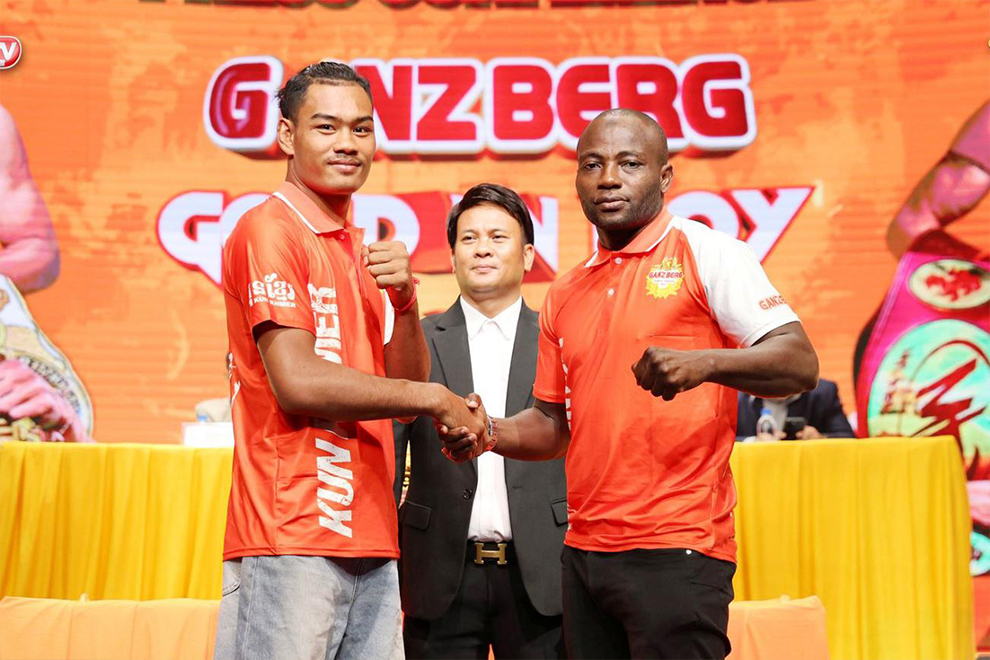
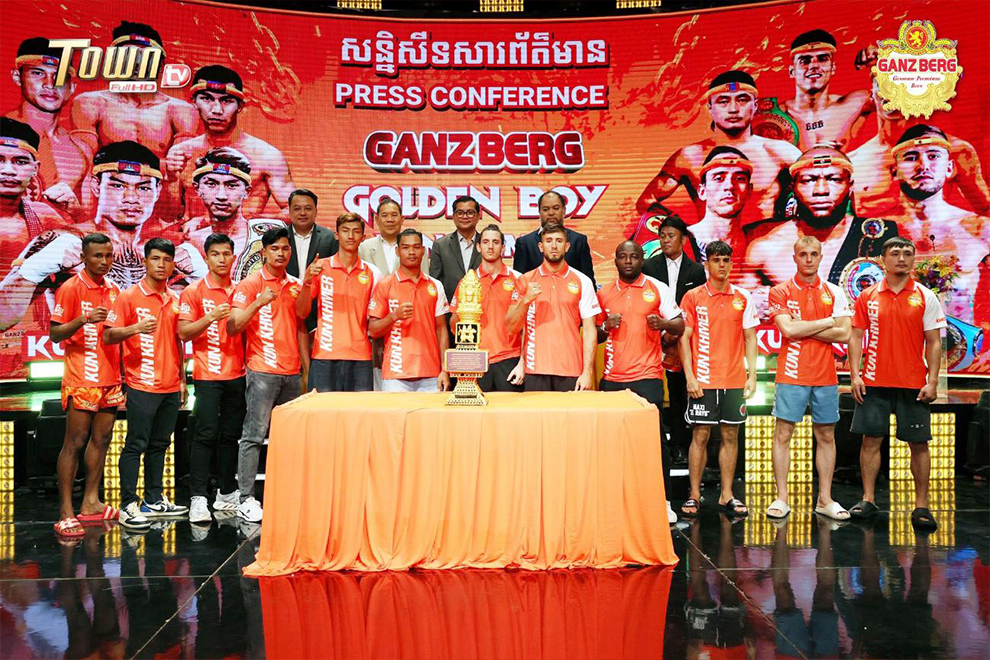
Legendary Kun Khmer exponent Thoeun Theara, along with five other Cambodian fighters — Lao Chetra, Maeun Meikhea, Chhut Serey Aannthong, Chomroeun Kumkhmer and Eh Amarinphounthong — are set to face off against international opponents tonight in a special “Golden Boy Kun Khmer” championship match, part of a major annual event organised by Town Arena in Phnom Penh. The bouts kick off at 8pm.
Thoeun Theara will take on world-class Ugandan fighter Amar Semata in the 73kg weight class, while Eh Amarinphounthong will meet Spain’s Javier Segura at 66 kg. His brother Maeun Meikhea is scheduled to fight Mongolia’s Bat Erdene at 63.5 kg.
Lao Chetra will face Spanish boxer Jose Manuel (70 kg), Chhut Serey Aannthong will fight Genis (60 kg) and Chomroeun Kumkhmer, known for his powerful knee strikes, will face Maxiel Rayo (60 kg), also from Spain.
Ahead of the event, Kim Srun Kosal (aka Tommy Kim), an advisor to Town TV and head of IPCC Cambodia, addressed a July 2 press conference. He highlighted that all twelve of the fighters are highly skilled, with multiple titles between them.
“This is a special event that happens only once a year. All of the Cambodian fighters here have passed the qualifying rounds and previously won the Golden Boy title. As for the six foreign fighters, they are all elite-level athletes, holding belts and titles, and have earned their right to participate,” he said.
Amar Semata, who has held multiple world championship belts, said he is familiar with Theara and is coming to Cambodia with a mission. He recalled how Theara defeated Thai star Saiyok Pumpanmuang in the first round with a devastating elbow that caused a major cut and forced a medical stoppage. Semata aims to “avenge” his friend Saiyok’s loss.
Despite this, Theara expressed confidence.
“I’ve trained hard and I’ve prepared my elbows. I want the world to recognise the power of Kun Khmer. This new trophy is beautifully designed in a distinctly Khmer style,” he noted.
Tommy Kim explained the three symbolic tiers of the Golden Boy Kun Khmer trophy.
The first features the figure of Brahma – representing Bayon Temple and the Brahmanic roots of Angkorian civilisation. Bayon carvings depict all forms of Khmer martial arts, including Bokator, Kun Khmer, long staff fighting and even grappling, which Tommy claimed are now repackaged internationally as MMA. The second tier features Hanuman (the monkey warrior) – symbolising the full range of Khmer techniques: knees, elbows, kicks and punches. These are core to traditional ring fighting.
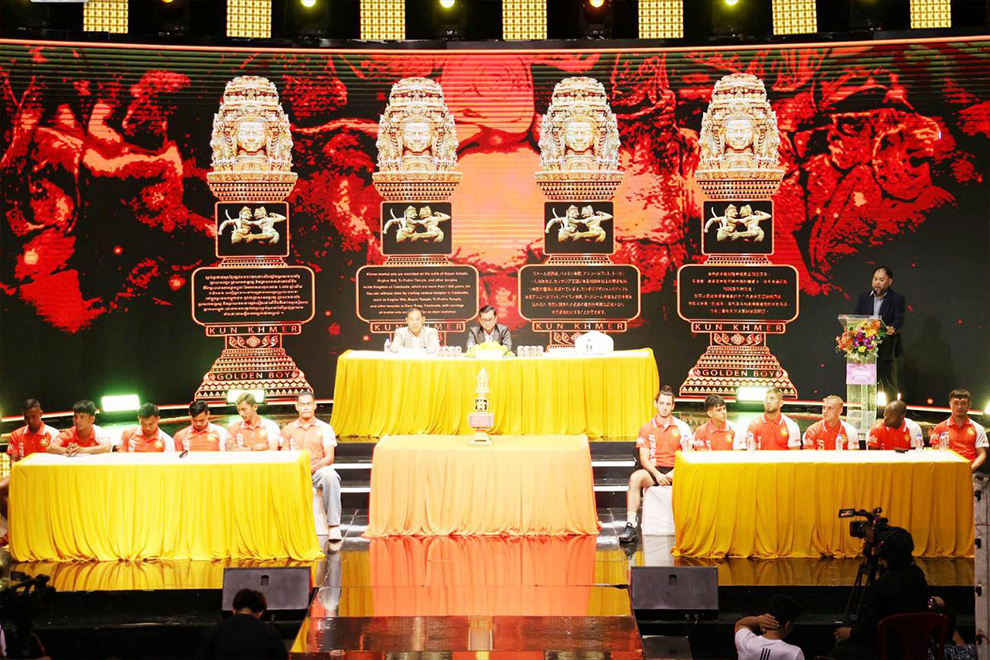
Finally, a written history of Kun Khmer is engraved in four languages (Khmer, English, Japanese and Chinese) to educate the world and promote research into the martial heritage displayed across Cambodia’s ancient temples.
“Our martial art dates back thousands of years — long before some neighbouring countries even existed. Kun Khmer was never copied from others. It’s clearly carved into the walls of Bayon Temple, and it’s time we proudly promote it. Some countries didn’t even exist when our temples were built — so they shouldn’t be claiming ownership of our martial heritage,” he said.
He added that the Cambodian martial arts legacy — preserved and passed down by ancestors — is a national treasure and must be upheld, celebrated and globally recognised through events like this.
