



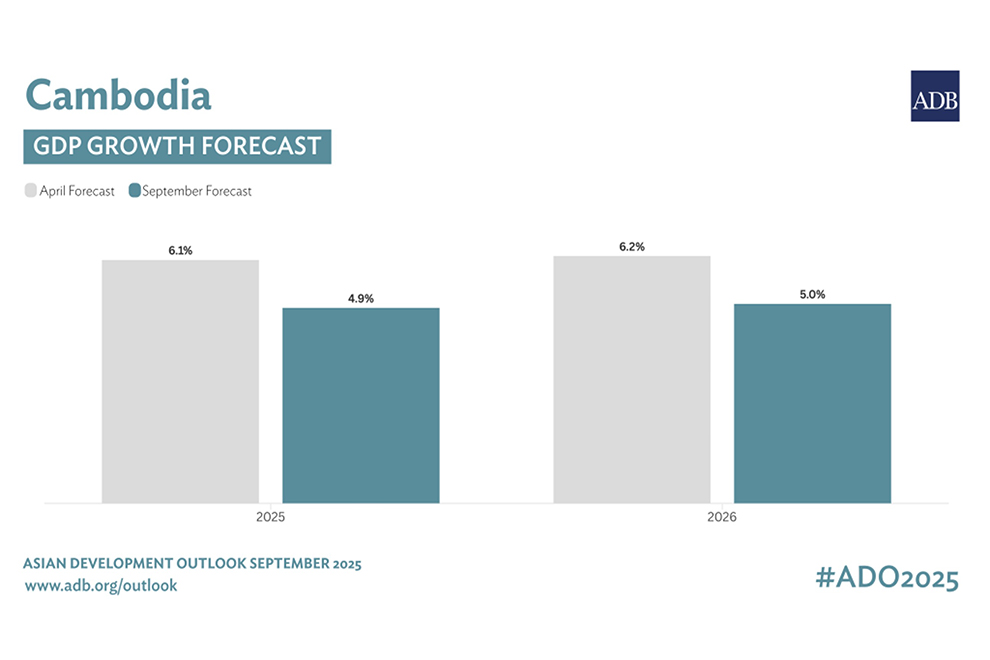
The Asian Development Bank (ADB) has reacted to economic challenges related to geopolitical tensions with Thailand and uncertainty surrounding the US export market, downgrading its growth forecast for Cambodia from 6.1% to 4.9% for 2025 and from 6.2% to 5.0% for 2026.
Regardless, solid growth is expected, thanks to the strength of the industrial sector and steady inflows of foreign direct investment.
“The economy has shown resilience in the first half of 2025,” said ADB country director for Cambodia Jyotsana Varma.
“Lower-than-expected food price increases and declining fuel costs helped ease inflation, while industrial activity remained robust. Looking ahead, there is scope for continued recovery in the construction and tourism sectors, alongside steady growth in agriculture, which together point to a more balanced and sustainable expansion,” she added.
In the just released Asian Development Outlook September 2025, the ADB reported that year-on-year inflation declined sharply from 6.0% in January to 1.6% in June. Inflation is expected to average around 2.0% in 2025 and 2026.
“Industry continues to be the main growth engine. Garment exports surged 22.2% year-on-year in the first half of 2025, partly due to US buyers stocking up in anticipation of higher tariffs on Cambodian imports. Despite cautious sentiment among importers stemming from trade policy uncertainty, the garment and non-garment manufacturing sectors are expected to remain strong, supported by a relatively favorable 19% US tariff rate,” it explained.
It projected moderate growth in the services sector, with 2.8% predicted in 2025 and 2.6% in 2026. While increased Chinese tourist arrivals in the first half of 2025 supported the recovery of the tourism sector, ongoing border tensions with Thailand are expected to dampen tourism and weigh on broader service activities in the second half of the year and beyond.
Sustained agricultural export demand and the return of migrant workers from Thailand should see the agriculture sector expand, albeit by just 1.1% in 2025 and 2026.
“Agricultural exports rose by 14.1% year-on-year in the first half of 2025, driven by robust shipments of cashew nuts and milled rice, which helped offset declines in cassava and rubber exports,” it noted.
