



In the past decade, the Ministry of Culture and Fine Arts has successfully marked 700 archaeological sites and confirmed 9,000 of the more than 10,000 scattered throughout the nation. This significant task has taken ten years of meticulous work.
Voeun Vuthy, the ministry’s heritage deputy director-general, revealed on August 3 that they have verified 9,000 sites but the remaining ones are yet to be examined. The unverified locations are often distant, and budget constraints coupled with the scope of work have hindered progress.
“It is necessary to follow subsequent steps to avoid conspiracy and conjecture,” he said.
The inspected 9,000 sites were closely scrutinised to ascertain their authenticity.
Vuthy explained: “Village and commune chiefs sometimes provide information about locations without knowing the exact details. When specialty officers visit these places, which are often just safety areas, they need to verify the information. If there is no historical evidence, the site is not considered archaeological”.
Of the 9,000 sites, Vuthy clarified that not all have been categorised as archaeologically significant ones yet.
“Without historical evidence, we will not consider them archaeological,” he said. “When sites are determined and analysed, they are called post-excavation stations. That means they have been classified”.
Vuthy expressed that the officials are eagerly continuing to manage archaeological sites across Cambodia.
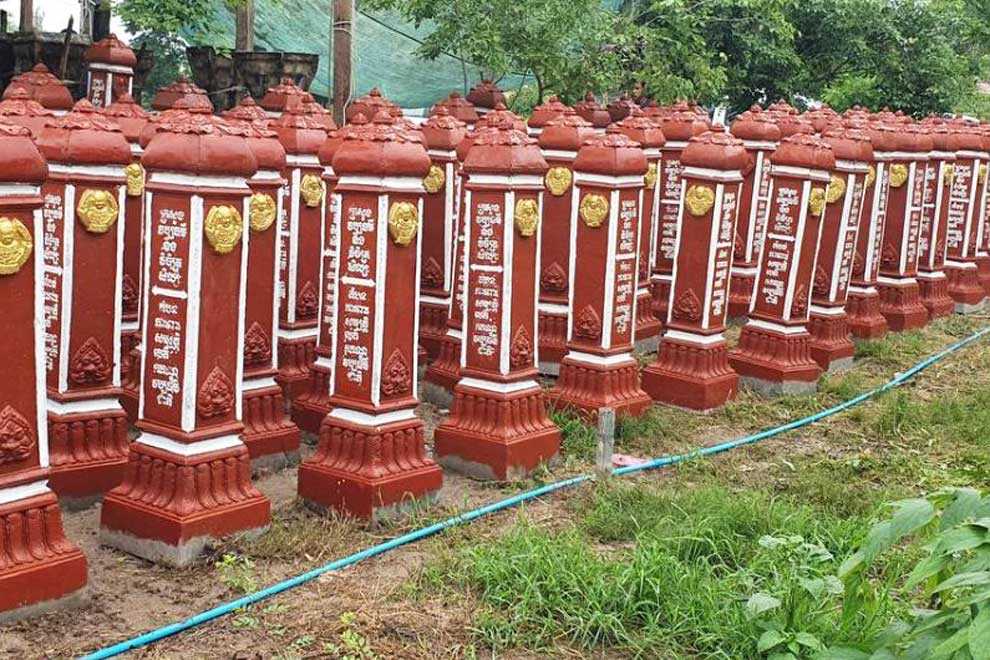
Recently, on August 2, he provided 100 border demarcation posts to Banteay Meanchey’s provincial department of culture and fine arts. These will mark 25 challenging archaeological sites.
“Banteay Meanchey has nearly 2,000 archaeological stations, but we chose only 25 stations for the department to set up posts at challenging locations,” Vuthy said.
He further explained the ministry’s decision to defer some of the work.
“In places that are remote or primarily used as worship sites, demarcation has been temporarily set aside. Other places are not allowed to demarcate because they are far away, and only worship places where not many people go to clear the land. We have set aside time to do this later,” he added.
Vuthy foresees the demarcation continuing for several more years. Although the plan predicts another decade of work, there is an intention to digitalise this process by 2025 to combat antiquity trafficking across ASEAN and neighbouring countries.
For 2023, Vuthy said the ministry plans to establish posts in four western provinces and complete one eastern province, Ratanakkiri, marking 60 challenging border locations.
In the last five years, the ministry has made significant progress in several key areas. They’ve registered inventories, classified model protection stations in nine provinces, certified 2,735 stations, and resolved 48 disputes over archaeological station land.
Additionally, they’ve actively promoted the law to protect heritage, focusing on 36 sites across various provinces that are at risk of destruction.
The efforts by the ministry have not only showcased their commitment to preserving the nation’s rich history but also set a precedent for cooperation, management, and digitalisation in the field of archaeology.
