



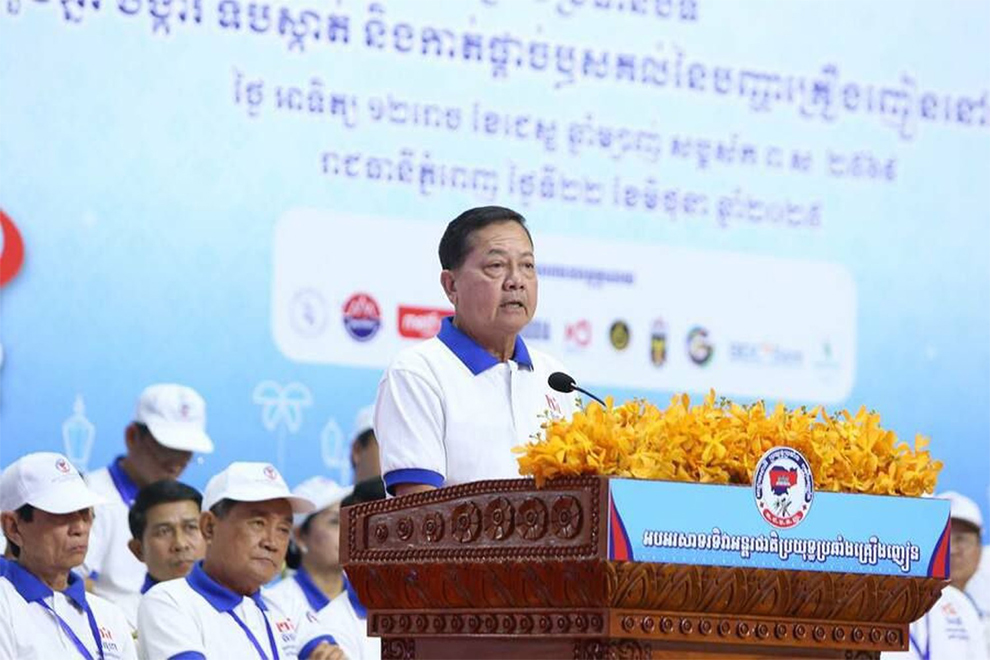
Drug use in Cambodian communities, nightclubs and clandestine drug production operations has significantly decreased over the past year, according to Deputy Prime Minister Neth Savoeun, head of Cambodia’s National Authority for Combating Drugs (NACD).
He shared his remarks during the celebration of International Day Against Drug Abuse and Illicit Trafficking on Sunday, June 22, at the National Olympic Stadium.
The theme for this year’s International Anti-Drug Day is: “Together, Prevent, Suppress and Uproot the Drug Problem in Cambodia.”
Speaking on behalf of Prime Minister Hun Manet, Savoeun acknowledged that although the drug problem in Cambodia has not been fully eradicated, several positive developments have emerged over the past year.
“We’ve observed a decline in drug use within communities compared to previous years,” he said, “thanks to increased public awareness and the strict law enforcement by our authorities.”
He added that drug use in nightclubs has also dropped notably, due to clear agreements between local authorities and venue owners, who strictly prohibit the distribution and use of drugs. Law enforcement has taken firm action against any violations without exception.
As for illegal drug production, authorities reported virtually no cases. In fact, in the first six months of 2025, no illegal drug productions have been discovered.
“All of this reflects encouraging trends and shows that under the clear-sighted leadership of the prime minister, Cambodia is heading in the right direction — with effective and determined efforts in our fight against drugs,” Savoeun emphasized.
However, he also pointed out that despite local successes, global security remains fragile, and this instability has allowed international criminal networks to expand drug-related operations worldwide — including production, trafficking and consumption. Unfortunately, Cambodia continues to be affected by these illicit activities.
In over the first five months of 2025, more than two tonnes of drugs and precursor chemicals were seized in 4,134 drug-related cases, resulting in the arrest of 10,765 people. Compared to the same period in 2024, the amount of drugs confiscated has dropped by about 50%.
Savoeun urged citizens to download and use the “No Drug” mobile application to anonymously report drug-related problems to authority around the clock.
“Using this app is like joining the government in the fight against drugs,” he said. “The more people use the app, the better our chances of removing drugs from our communities.”
The App No Drug was officially launched in April 2024. As of now, nearly 50,000 people have downloaded it. Citizens have submitted reports on more than 1,400 drug-related incidents, and authorities have responded to and addressed around 1,200 of those cases.
