



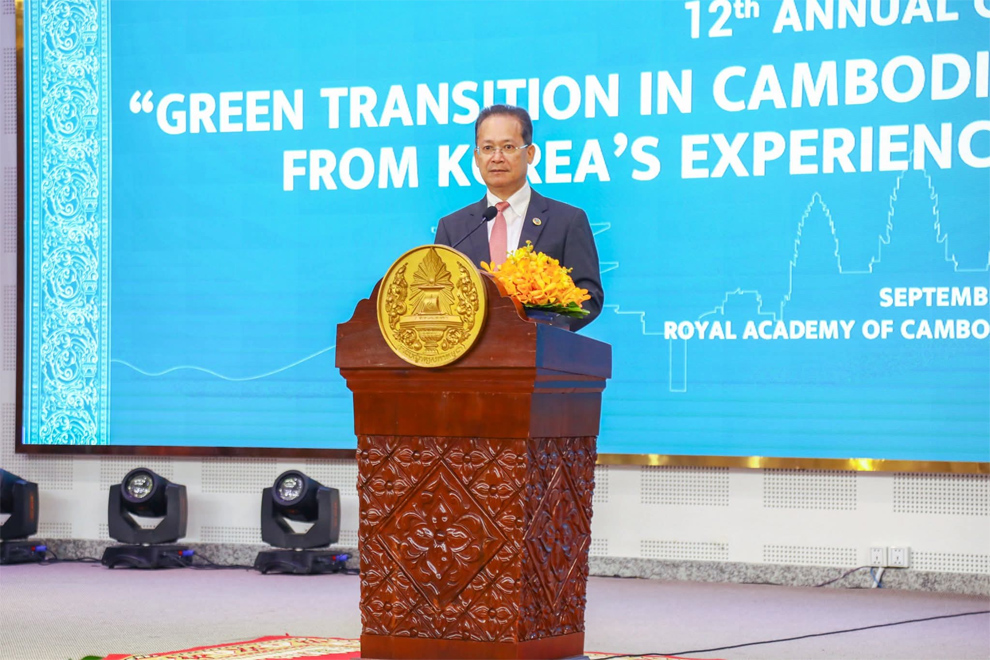
Cambodia has urged enhanced regional cooperation by developing priority plans aimed at environmental cleanliness, green growth, and responses to climate change.
The appeal was made by Minister of Environment Eang Sophalleth, who presided over the opening of the “Green Transition in Cambodia, Laos and Vietnam: Insights from Korea’s Experience and Future Pathways” convention. The September 30 event was organised by the Royal Academy of Cambodia, with the participation of the Environmental Management Institute of South Korea.
The minister called on participating countries — Laos, Vietnam and partners such as South Korea — to jointly create priority plans and actions to combat environmental pollution, protect and conserve natural resources, and collectively respond to climate change.
“We share the same water, we breathe the same air and we have the same forests, which require joint measures to prevent negative impacts on the environment and natural resources,” he said.
He noted that Cambodia has implemented transparent, effective legal measures to prevent environmental pollution, under the leadership of Prime Minister Hun Manet, through clear policies and strategies.
Under his leadership, the environment ministry has implemented the Circular Strategy on Environment, which aligns with phase one of the government’s Pentagonal Strategy. It has launched numerous campaigns aimed at cleanliness — specifically clean land, clean air and clean water — as well as efforts to prevent and crack down on natural resource crimes and illegal encroachment on forest land.
He further noted that recently, through cooperation between the ministry of Environment, other government institutions and the private sector, as well as the participation of students, teachers, monks, local authorities at all levels, NGOs, civil society and more than half of the country’s citizens, several campaigns have been implemented.
These include the “Today, I Will Not Use Plastic”, “Clean Cambodia, Khmer Can Do” and “Clean Roads Without Trash and Plastic Waste” campaigns.
These efforts have gradually improved cleanliness in communities, national roads and public spaces, and have reduced plastic imports by 85%, said Sophalleth.
Additionally, through the current clean water campaign, Cambodia has prevented contaminated water from entering public water sources. In the first nine months of 2025, the ministry stopped approximately 15 million cubic metres of polluted water from being discharged. At the same time, the country has been working closely with subnational administrations, law enforcement, authorities and anti-corruption bodies to strengthen law enforcement, suppress numerous natural resource crimes and reclaim many hectares of forestland for the state.
The minister also encouraged greater cooperation among the Royal Academy of Cambodia, the Lao Academy and the Vietnamese Academy to address environmental and natural resource issues. This includes the creation of priority action plans to urgently halt activities that cause environmental pollution from factories and enterprises, jointly protect forests and natural resources, reduce greenhouse gas emissions and respond to climate change.
“Together, we move forward to expand cleanliness, expand green coverage, and we can all contribute — for humanity and toward the goal of becoming carbon-neutral by 2050,” Sophalleth suggested.
