



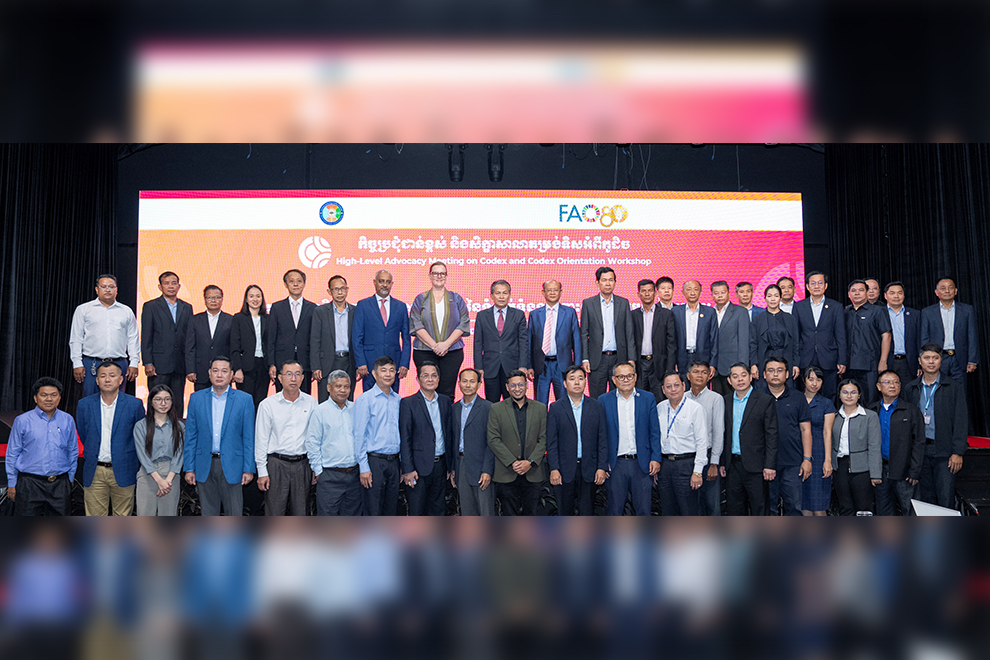
Cambodia has reaffirmed its commitment to food safety and international standards through two national workshops, held in Phnom Penh his week.
Led by the Ministry of Industry, Science, Technology and Innovation (MISTI), with technical support from the UN Food and Agriculture Organization (FAO), the events are part of the Codex Trust Fund (CTF) 2024–2026 project, which aims to strengthen Cambodia’s capacity to engage more actively with Codex Alimentarius Commission, which seeks to develop international food standards.
A high-level advocacy meeting on Codex was held on Tuesday, 27 May, bringing together senior government officials and policymakers to reinforce the Kingdom’s national commitment to Codex and food safety governance.
The meeting was opened with remarks from innovation ministry secretary of state Ke Ky and Rebekah Bell, FAO representative in Cambodia.
The event emphasised Cambodia’s role in shaping Codex standards and the importance of integrating Codex work into national policy agendas.
Codex plays a vital role in protecting consumer health, promoting fair food trade and harmonising global food safety standards.
“For Cambodia, strengthening Codex engagement is key to ensuring food safety, facilitating trade and supporting sustainable development,” explained a press release.
The Codex Alimentarius, or “Food Code,” is a collection of internationally recognized food standards, guidelines, and codes of practice adopted by the Codex Alimentarius Commission (CAC) — a joint intergovernmental body established by FAO and WHO.
Following the advocacy meeting, the Codex Orientation Workshop will take place on May 28 and 29. It will target technical officers and key stakeholders from government agencies, academic institutions and regulatory bodies.
The workshop aims to build a strong technical foundation for Codex participation by enhancing understanding of Codex structures and procedures, strengthening the development of Cambodia’s National Codex Committee (NCC) and Codex Contact Point (CCP), and equipping national experts to contribute effectively to Codex standard-setting.
The two workshops are being held to raise awareness among senior policymakers about the significance of Codex for consumer protection and trade and to improve technical capacity for using Codex standards and risk analysis in national food regulation. It also supports the institutionalisation of Cambodia’s Codex mechanisms, ensuring long-term and active engagement in global standard-setting processes.
These workshops mark an important milestone in Cambodia’s journey to develop a robust, inclusive and internationally aligned food safety framework that protects consumers and enables trade.
Cambodia has been a member of the Codex Alimentarius Commission since 1974 and has made steady progress in strengthening its food safety systems. With renewed momentum and support from the Codex Trust Fund, Cambodia is now focused on enhancing national structures, building technical expertise and fostering greater coordination to play a more active and sustained role in Codex work.
