



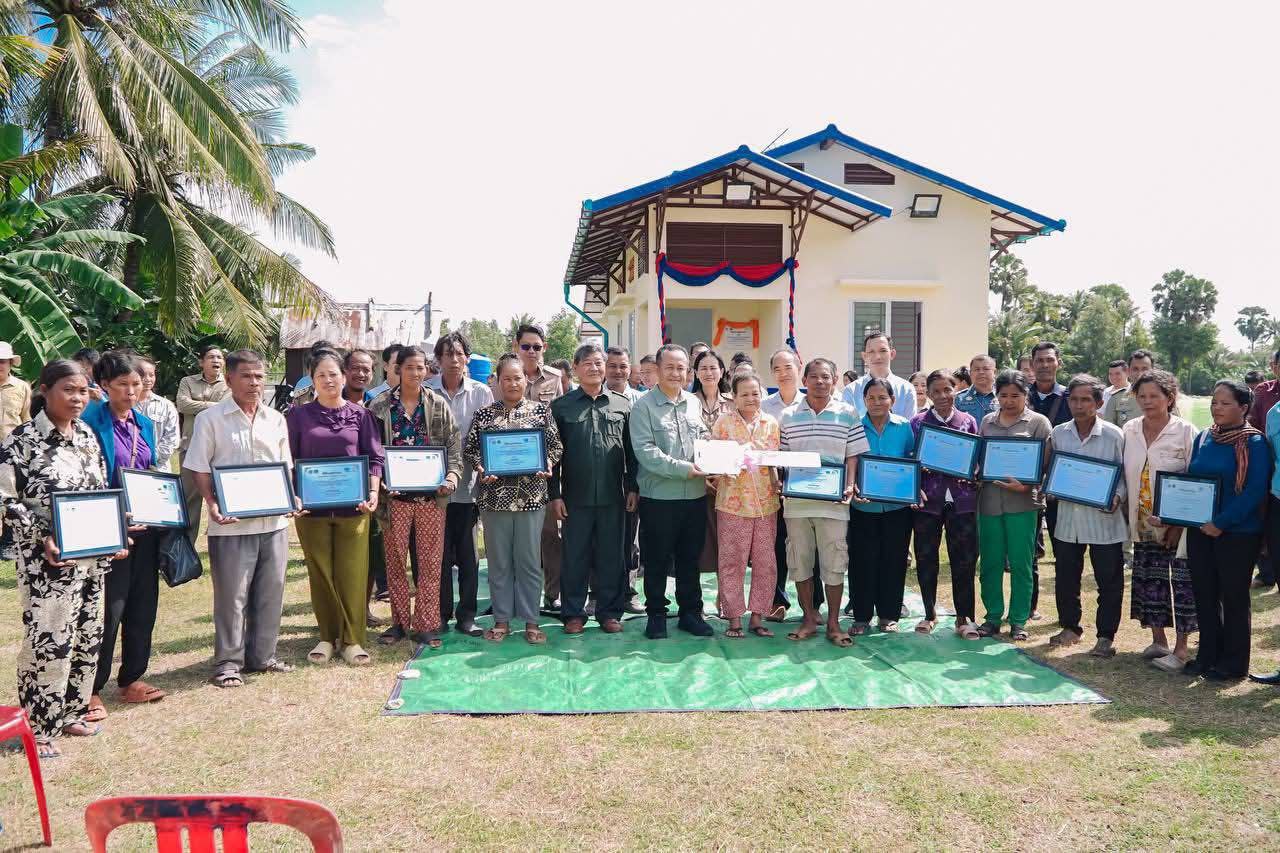
A dozen homes which were specially designed to resist the effects of climate change have been presented to impoverished families in Kep province.
The houses were built to be resilient against strong winds and represent a form of climate adaptation for the recipient families in Damnak Chang Eur district and Kep town.
The July 26 presentation ceremony was attended by Ministry of Environment undersecretary of state Pheav Sovuthy, Kep provincial governor Som Piseth and UN-Habitat country representative in Cambodia Sok Vanna.
Sovuthy explained to the attendees that the effects of climate change are being felt more frequently and with greater severity, particularly in coastal areas. This manifested in stronger winds, storms, rising temperatures, irregular rainfall patterns and saltwater intrusion into agricultural zones.
“These climate-resilient houses are specially constructed to be strong and wind-resistant, with good lighting and ventilation,” he noted.
He urged the beneficiary families of the project to take care of their new homes, suggesting that they plant trees around their residences, which would support one of the environmental priorities laid out in Cambodia’s environmental sector strategy.
He also highlighted several key campaigns led by the environment ministry, “Today I Will Not Use Plastic”, “Clean Cambodia, Khmer Can Do”, the Plastic-Free National Road Initiative, and the Ponlok Baitong campaign. This year, the ministry plans to distribute over three million saplings to the public.
The new homes were supported by the project the “Climate Change Adaptation through small-scale and Protective Infrastructure Interventions in Coastal Settlements of Cambodia” (CCA4CS), and implemented directly by the Kep provincial administration.
Governor Piseth acknowledged the significance of the project, while offering his gratitude to the environment ministry for for its continued support of the province in tackling climate change.
He noted that the project, directly implemented by the province, was carried out effectively, transparently and sustainably, and could serve as a model project for linking policy with on-the-ground action in responding to climate change at the local level.
“The 12 houses were selected, evaluated and monitored directly by the province, and allocated to genuinely poor families with no other support,” he said.
Sok Vanna explained that the project’s goal is to contribute to the government’s climate change adaptation efforts through small-scale infrastructure, including building floodgates, restoring canals, constructing climate-resilient houses and planting mangrove forests, among other initiatives.
The successful completion and handover of the 12 homes were the result of strong cooperation with the provincial and local authorities, he added.
The beneficiaries of the homes have agreed that they will not transfer, lease, mortgage or donate the homes within five years of receiving them.
