



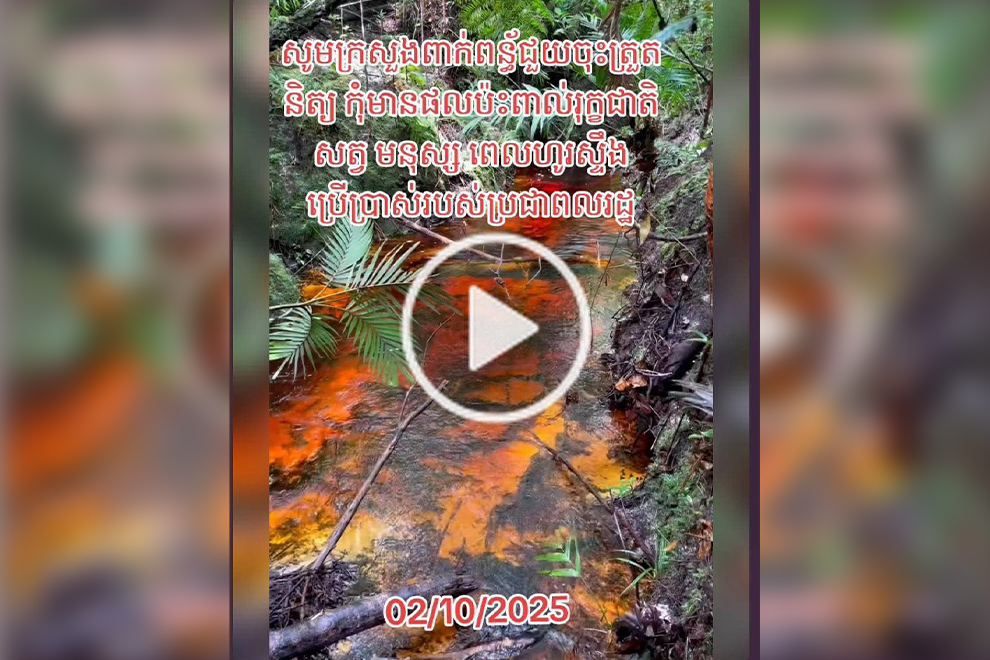
Following a widely shared video which showed a stream which has turned yellow, officials from the Ministry of Environment have launched an investigation into the incident, which reportedly occurred in the Cardamom Mountains National Park, in Koh Kong province. They are searching for the location, and will then collect water samples and conduct laboratory testing to determine the cause of the discolouration.
“Officials are collaborating with the provincial Department of Environment to identify the site, then collect water samples for analysis at the ministry laboratory,” said a ministry statement released this morning, October 3.
The video, posted to a social media account called suuhaaksuujin, showed a man examining the stream, surrounded by dense forest.
“I urge all related ministries to inspect to ensure the safety of the plants, animals and humans. This water flows to a place where it is used by local residents,” he said.
Source: suuhaaksuujin
The ministry noted that changes in water colour — from clear to cloudy or yellowish (earthy or resin-like colours) — can naturally occur in mountain forest areas during the rainy season.
It added that heavy rainfall often causes runoff and changes in water colour, sometimes turning tea-coloured, pale yellow-brown or reddish-black. This is usually the result of soil composition, peat-like land or streambed sediment, as well as organic materials from tree trunks, roots and resin released after branches break or fall due to heavy rain and strong winds.
The ministry expressed its appreciation for public cooperation in reporting environmental issues, which helps the ministry enforce environmental laws and manage natural resources to protect Cambodia’s future — especially of environment, human life and wildlife.
The ministry also urged the public — especially journalists and social media content creators — to cooperate and report environmental concerns to the monitoring, prevention and investigation of potential environmental offenses.
At the same time, it requested an end to the spread of misinformation about environmental issues that could mislead the public, violate journalistic ethics or and negatively impact the economy, society or people’s livelihoods.
The ministry announced that from January to the end of September 2025, it prevented more than 13 million cubic metres of wastewater from polluting public water areas. In September alone, nearly 2 million cubic meters of wastewater from companies and factories were stopped from contaminating clean water sources in the capital and provinces.
Ministry spokesperson Khvay Atitya stated that enforcement against environmental pollution is carried out regularly. The ministry has instructed companies and factories with potential pollution risks across the country to comply with environmental and natural resource regulations by installing automated monitoring systems and data management systems for liquid waste discharge at their sites.
He said that as of September 30, 57 companies and factories had signed formal commitments to comply with the law, with 46 of them already installing the required automated monitoring equipment.
