



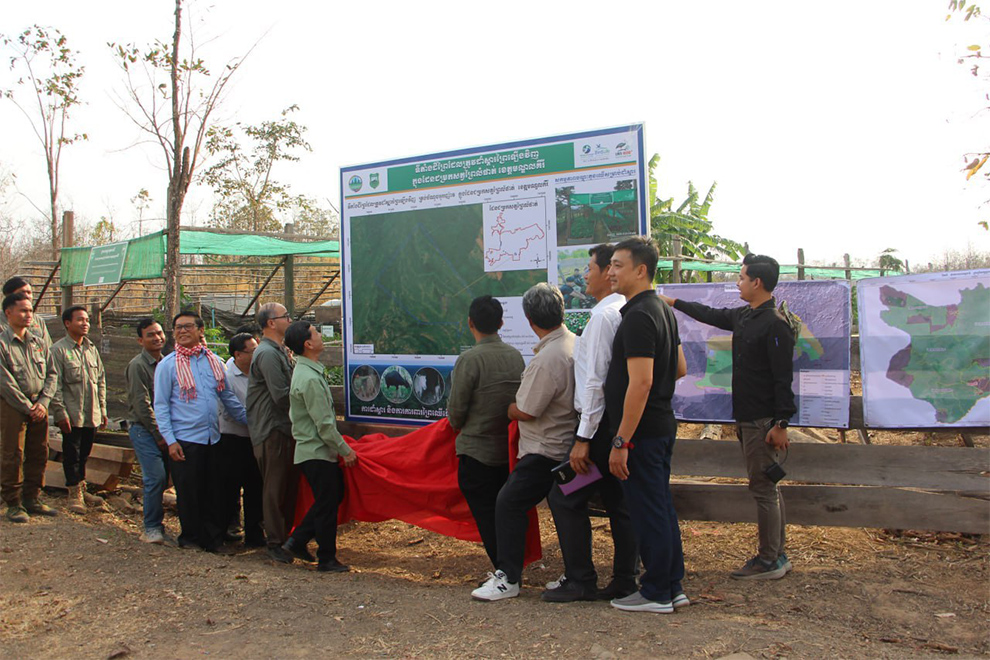
NatureLife Cambodia has announced plans to reforest more than 1,700 hectares of land in Mondulkiri province that was illegally cleared. Their operations will be supported by the Lumphat Wildlife Sanctuary REDD+ Project.
Bou Vorsak, executive director of NatureLife Cambodia (NLC), told The Post that to regenerate forest cover on the land – in the Lumphat sanctuary – thnong, beng, kokoh and chres trees will be planted.
“Our reforestation efforts aim to prevent further forest loss due to opportunistic encroachment, reduce heat, mitigate erosion and address climate change,” he said.
Chuop Paris, secretary of state at the Ministry of Environment and national REDD+ official, visited the sanctuary’s central Royorleu station and tree nursery in late January.
NLC stated that the purpose of the visit was to inspect progress on infrastructure development at the station and prepare for the launch of the tree-planting initiative, which is funded by the REDD+ project.
The reforestation will take place on a total area of 1,762.90 hectares of land that was reclaimed from illegal encroachment. For the first phase, a pilot planting will take place over 10 hectares during the current rainy season, with a focus on native tree species that are found in the area.
Lumphat Wildlife Sanctuary spans a total of 356,087 hectares across four provinces, Ratanakkiri, Mondulkiri, Kratie and Stung Treng. The sanctuary is home to several communities —mostly indigenous people — who rely on non-timber forest products.
The sanctuary includes dense forests, semi-dense forests and grasslands. They provide critical habitats for a wide range of wildlife, including 23 species of mammals, 194 bird species and 5 species of reptiles.
The area eligible for REDD+ implementation is limited to approximately 130,000 hectares within Koh Nhek district in Mondulkiri, and Kon Mom and Lumphat districts in Ratanakkiri.
NLC is working with the environment ministry and the provincial environment departments in Mondulkiri and Ratanakkiri to implement the REDD+ project. They are focussed on strengthening law enforcement, biodiversity research, and promoting community participation, while improving livelihoods in and around the sanctuary. Implementation began in late 2023.
In addition, the REDD+ project has supported the construction of infrastructure at the central station in Royorleu, including a meeting hall, office spaces, campsites, restrooms, tree nurseries and the renovation of ranger accommodation.
Vorsak noted that the REDD+ project is currently undergoing its final stage of audits by independent auditing company, SCS Global Services. After the audit, the company will submit a report to the carbon credit agency VERRA. VERRA is an independent international body, and is authorised to register, validate, verify and issue carbon credits for sale on international markets.
“If the audit is successful, verification will follow in 2026, and assuming there are no changes, we will issue our first round of carbon credits,” he said.
