



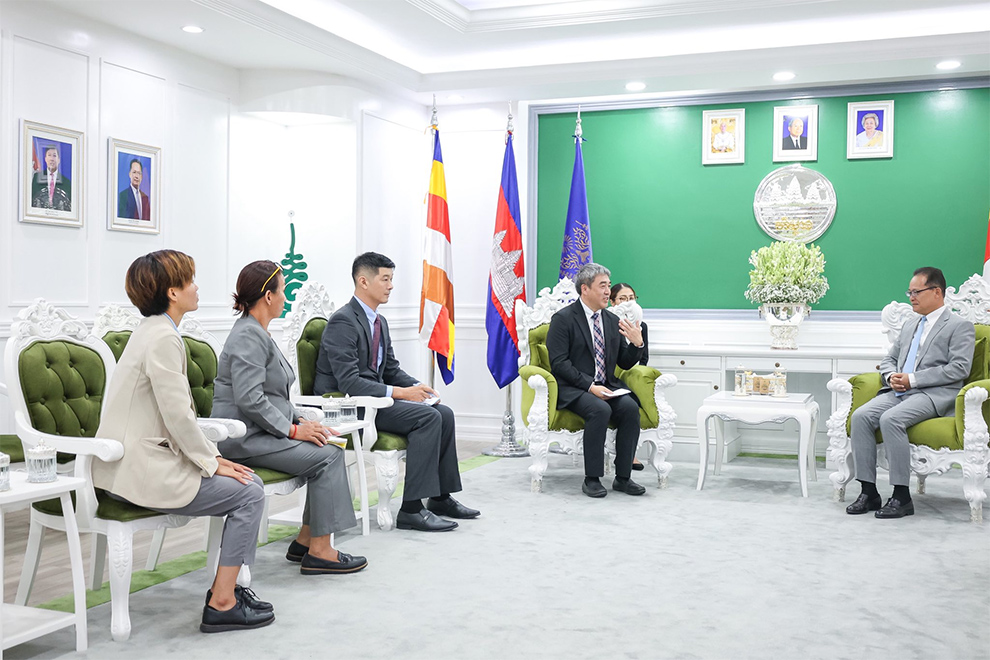
Japanese company GOMI Recycle 110 Co., Ltd., which has more than a decade of experience in waste recycling in Cambodia, has announced plans to expand its operations to several provinces and remote districts to support the education of poor students through recycling, in cooperation with the Ministry of Environment.
The Cambodia-Japan partnership project was revealed during a July 1 meeting between environment minister Eang Sophalleth and Yusuke Okumura, chairman of the board of GOMI Recycle.
With its long experience managing and recycling waste in Cambodia, GOMI Recycle expressed a strong desire to strengthen its collaboration with the ministry. The desire for closer ties were in response to a recommendation made by Prime Minister Hun Manet during a may visit to Japan, the ministry explained, in a July 2 statement.
“GOMI Recycle 110 Co., Ltd. has plans to install machines that can recycle plastic waste, bottle caps and other materials — machines that can operate even in remote areas and produce usable items,” noted the ministry.
Sophalleth offered his full support for the initiative and encouraged the company to begin by installing Japanese-standard recycling machines in one district of a target province as a pilot project. If successful, the programme could be scaled up to the entire province, helping the company achieve greater impact.
The ministry added that it would provide plastic waste and recyclables collected by students through the “Clean Cambodia, Khmer Can Do” campaign. The proceeds from selling the recycled products will go toward supporting the education of students in rural schools.
“We are working with the company to help support the education of poor students in remote rural schools,” it added.
Investment in plastic waste recycling in far-flung areas aligns with the guidance and goals of the prime minister — to keep Cambodia clean, address climate change and move toward the vision of Cambodia becoming a carbon-neutral country by 2050.
Nationwide, over 10,000 tonnes of waste are generated each day in the Kingdom. Annually, this amounts to nearly 4 million tonnes. In Phnom Penh alone, up to 5,000 tonnes of waste are generated daily. However, only 50 to 60 per cent is collected and dumped in landfills. Recycling remains limited, accounting for just 10 to 15 per cent.
This situation has led to a steady increase in the volume of waste. Of all daily waste generated, approximately 60 to 65 per cent is organic, 20 per cent is plastic, and over 10 per cent consists of solid waste, including electronic waste.
