



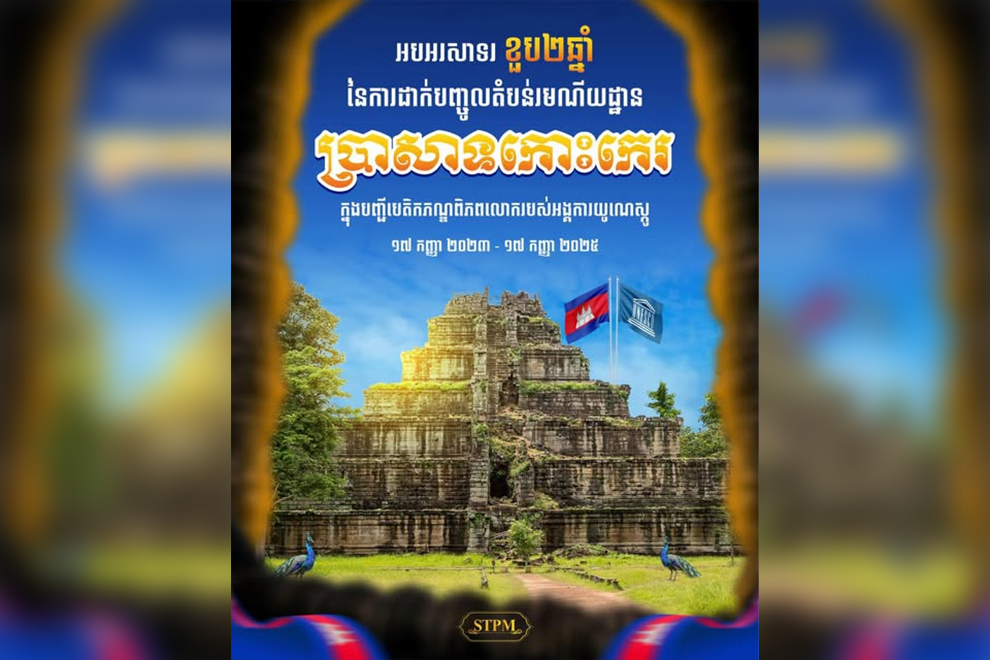
Prime Minister Hun Manet has noted that every one of the Kingdom’s citizens shares equal ownership of Cambodia’s cultural and natural heritage, and thus carries the responsibility to help protect, conserve and promote the Koh Ker Temple complex.
This preservation is essential not only for national development and improving people’s livelihoods, but also for strengthening Cambodia’s identity on the international stage, he explained, in a congratulatory message marking the 2nd anniversary of Koh Ker’s inscription on the UNESCO World Heritage List, on September 17.
Manet emphasised the importance of cooperation among all relevant institutions — especially the Preah Vihear provincial authorities and the National Authority for Preah Vihear (NAPV) — to carefully manage and preserve the temples, archaeological sites, traditions, local communities, land, forests and wildlife in line with the principles of the UNESCO World Heritage Committee.
He highlighted that the recognition of Koh Ker — once the royal capital founded by King Jayavarman IV during the height of the Angkorian Empire, renowned for its temples, sculptures, inscriptions, urban planning knowledge and ancient hydraulic systems — demonstrates Cambodia’s remarkable cultural prestige on the international stage.
This success reflects the tireless and heroic efforts of the Royal Government of Cambodia, made possible under the peace achieved through the “Win-Win Policy” of Senate president Hun Sen, which united the nation and created harmony as a foundation for national development in all sectors, including the preservation and promotion of cultural heritage and Khmer traditions passed down by the ancestors, he added.
The prime minister also praised the leadership and officials of the Ministry of Culture and Fine Arts, the NAPV, domestic and international experts, partners and dignitaries for their dedication, professionalism and perseverance over the past two years.
He noted achievements such as the conservation and restoration of Prasat Balang Cheung, Prasat Pram, Prasat Krahom, Prasat Kok Krong and other key archaeological studies that shed light on the extraordinary history of the period.
On this occasion, UNESCO reaffirmed that since its inscription on 17 September 2023, UNESCO — together with the NAPV and other key partners — continues to promote sustainable tourism, community engagement and the protection of Koh Ker for future generations. Their actions are being carried out through disaster risk resilience initiatives, archives management system development, mine clearance and anti-trafficking efforts and conservation and restoration planning.
“With five sites inscribed on UNESCO’s World Heritage List, Cambodia’s rich and diverse heritage is recognised internationally for its outstanding universal value and its contribution to the shared history of humanity,” it stated.
To commemorate the 2nd anniversary of Koh Ker’s World Heritage inscription, the Preah Vihear provincial administration, in cooperation with the NAPV and the Union of Youth Federations of Cambodia (Preah Vihear branch), also organised a 9-kilometre community run on the Koh Ker Trail at the temple complex on September 17.
