



Prime Minister Hun Manet has informed UN secretary-general António Guterres about recent developments in the ongoing Cambodia-Thailand border tensions, warning him that they pose a grave threat to peace and stability between the two nations and the wider region.
In a September 17 letter, he informed Guterres that he had written to 2025 ASEAN chair Anwar Ibrahim, Prime Minister of Malaysia, to draw his attention to the recent developments.
He highlighted that the ceasefire agreed on July 28, in Putrajaya, Malaysia halted the large-scale fighting that began on July 24, which took place in the northern provinces of Preah Vihear and Oddar Meanchey in Cambodia.
However, Manet noted that regrettably, Thai military activities in violation of the ceasefire have continued and even extended beyond the original areas of conflict.
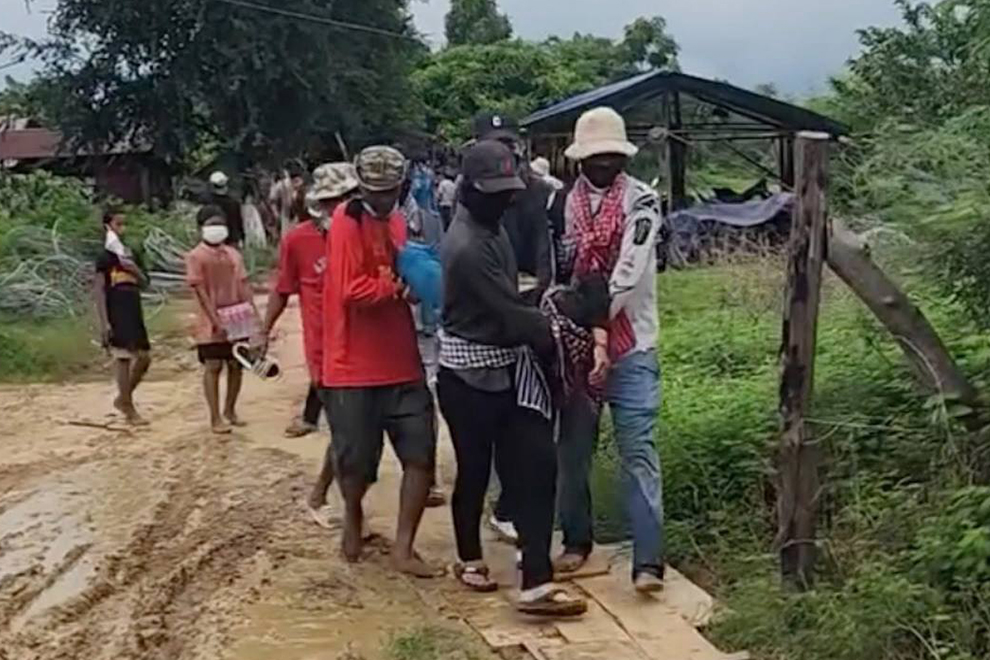
Since August 12, he explained, Thai forces have widened the conflict zone by erecting razor wire and barricades, issuing ultimatums and forcibly evicting Cambodian civilians from long-settled lands in Banteay Meanchey province’s Chouk Chey and Prey Chan villages. The villages are in the north-western part of Cambodia, a few hundred kilometres away from the above conflict zones.
Twenty-five families have already been denied access to their homes and fields, and a Thai military spokesperson recently threatened further evictions in the very near future, potentially affecting hundreds of households.
In addition, Manet said that “credible sources” had informed him that the Thai military intends to use force to seize territory at 17 other locations in provinces from Pursat to Koh Kong, at the western and south-western parts of Cambodia.
He stated that the actions taken by the Thai military are based on unilaterally drawn 1/50,000 scale maps, contrary to the mutually agreed 1/200,000 maps which were drawn up by the Commission of Delimitation of the Boundary between Indo-China and Siam set up by the Convention of 1904 and the Treaty of 1907 between France and Siam.
The 1/200,000 maps have been recognised by the International Court of Justice (ICJ) and reaffirmed by Cambodia and Thailand in a memorandum of understanding on the Survey and Demarcation of Land Boundary signed on 14 June 2000 (MoU 2000). Thailand registered this MoU at the UN on May 25, 2001, and it was published in the UN Treaty Series.
Thai actions constitute an attempt to unilaterally demarcate the boundary through the use of force, in direct violation of the MoU 2000, the mandate of the Cambodian-Thai Joint Commission on Demarcation for Land Boundary (JBC) and the commitments recorded in the recent GBC and Regional Border Committee (RBC) meetings, noted the prime minister.
“Both sides agreed not to undertake provocative actions that may escalate tensions… or expand the scope and scale of the disputes,” stipulated the recorded commitments.
According to Manet, these unilateral measures, including the extraterritorial application of Thai martial law, represent an unacceptable breach of Cambodia’s sovereignty and a clear violation of international law, including the UN Charter, the ASEAN Charter and the Treaty of Amity and Cooperation in Southeast Asia. In addition, these actions not only constitute a grave infringement of human rights, but also create risks of violent confrontation.
In the spirit of de-escalation and ASEAN centrality, Manet has requested the prime minister of Malaysia, in his capacity as ASEAN chair, to urge Thailand to adhere strictly to the ceasefire and relevant agreements reached at Putrajaya on July 28, as well as recent GBC and RBC meetings. He has asked that they immediately cease all unilateral actions, which may escalate tensions and expand the scale and scope of the conflict, and to refrain from the use of force against civilians and properties.
He also urged the removal of newly placed obstacles, such as razor wire and tyres barricades, within areas where Cambodian people have been living for decades and within areas where demarcation has not been completed. Manet called for a halt to planned forced evictions, and to allow the Cambodian people who have been evicted to return to their homes and land.
The prime minister also demanded a stop to the use of military force to carry out unilateral boundary demarcations and let existing bilateral mechanisms, namely the JBC, to continue to do the work in a peaceful manner, based on existing agreements, conventions and treaties, and international law.
In addition, Manet called for the immediate and unconditional release and return of 18 captured Cambodian soldiers who remain in Thai custody.
He reiterated Cambodia’s commitment to a peaceful resolution of the dispute in full conformity with international law and to working with Thailand and ASEAN to preserve stability, foster cooperation and promote the well-being of both peoples.
“I truly hope that the above information will be received in a spirit of shared commitment to peace and constructive dialogue, and that Your Excellency will kindly consider offering your valuable support through appropriate channels to help encourage the full and effective implementation of the ceasefire and all the agreements reached by Cambodia and Thailand. Your continued leadership and engagement would be instrumental in preserving stability and fostering a peaceful resolution to the current situation,” the letter concluded.
