



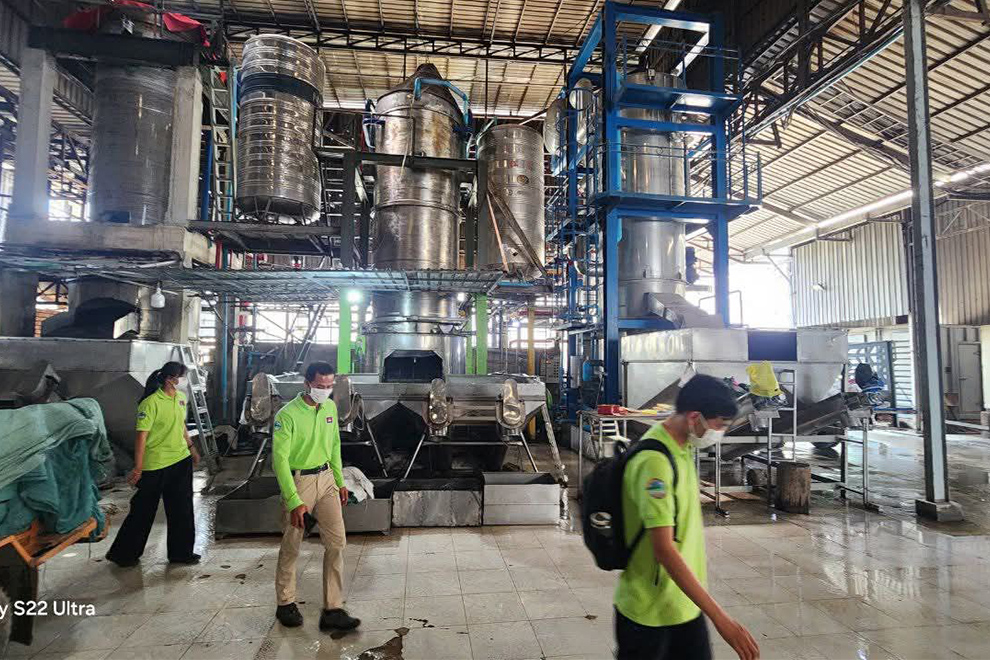
The Ministry of Environment is pursuing legal action against an ice production factory that emitted ammonia gas, disturbing nearby residents and affecting public health, while national and local authorities continue efforts to reduce air pollution during the dry season.
On Wednesday, December 3, the ministry reported that its environmental inspection team investigated an ammonia gas leak at the Chheng Sopheary Ice Factory, located in Trapaing Thleung 4 village, Choam Chao I commune, Por Senchey district, Phnom Penh.
“Specialists found that the factory emitted a foul odour (ammonia gas), disturbing residents and affecting public health, which violates Article 161 of the Environmental and Natural Resources Code,” the ministry stated.
The team measured the ammonia concentration at the factory and found NH₃ levels reaching 1.0 mg/m³, while the standard limit is only 0.2 mg/m³. This excessive concentration also violates the Environmental and Natural Resources Code.
The ministry has taken legal action against the factory for violating environmental regulations. The facility has been ordered to regularly monitor its ammonia storage and exhaust systems to prevent future leaks, and to request an indoor air quality certification to comply with national standards.
The inspection team was led by Chab Yuthy, deputy director of the Department of Environmental Protection, with officials from the Ministry of Industry, Science, Technology and Innovation, Ministry of Labour and Vocational Training, Phnom Penh Department of Environment, Por Senchey district authorities and local authorities.
These actions come as the environment ministry strengthens cooperation with provincial and municipal administrations to reduce public air pollution during the dry season.
On December 3, the Kampong Chhnang provincial administration instructed all city and district authorities to strengthen measures to prevent and reduce air pollution.
The administration noted that each year from December to April, air quality drops across the province, especially due to rising levels of particulate matter (PM2.5 and PM10), which may exceed standard limits — posing risks to public health and the environment.
They identified key sources of particulate pollution are forest fires, burning grasslands, agricultural waste, shrubland and stubble, household waste and plastics in open areas, fires at landfill sites, emissions from factories and dust from construction sites.
To address this, provincial authorities instructed departments and administrations to educate and advise citizens not to burn grasslands, agricultural waste, shrubland, stubble, household waste, solid waste or plastics in open areas and prevent fires at landfill sites.
They were also instructed to control dust pollution at construction sites and during material transportation, maintain roads and public areas regularly and prepare equipment to respond quickly to fires involving grasslands, agricultural waste, shrubland, stubble or other burning waste.
The provincial administration also ordered all companies, factories, enterprises, and handicraft operations to immediately stop burning textile scraps or industrial waste in boilers or kilns without proper air-filtration systems.
They must also install emission control systems to ensure compliance with air-quality standards.
“If any business owners or factories fail to follow the above measures, provincial authorities instruct all relevant departments and local administrations to immediately enforce legal measures in accordance with the law — especially the Environmental and Natural Resources Code — without exception,” the administration warned.
