



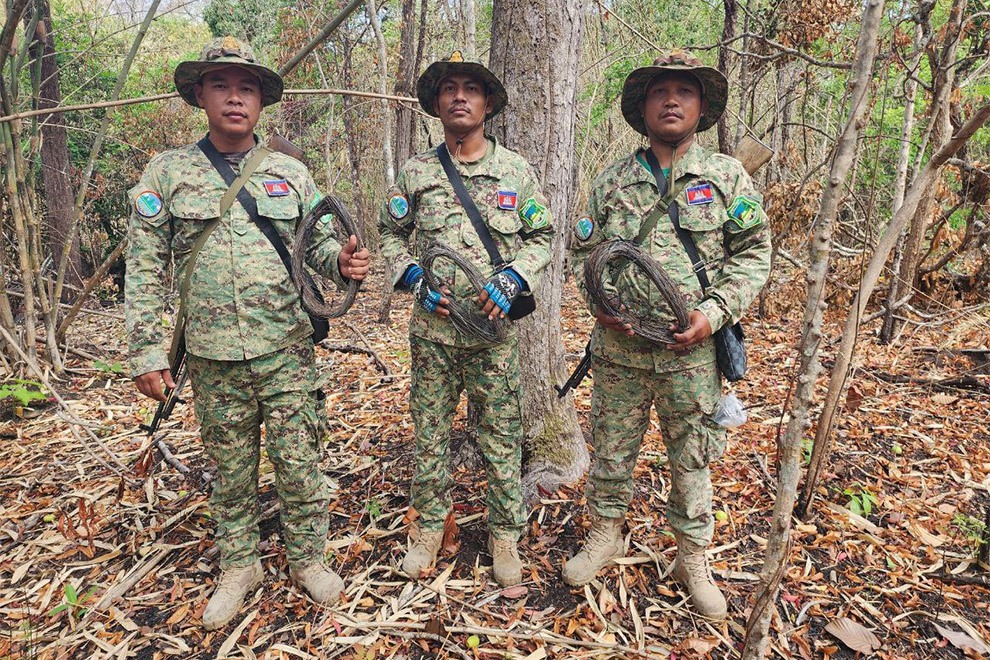
The Ministry of Environments latest report on natural resource crimes reported a 27% decrease in the number of crimes it intervened in from January to June, when compared to last year. It recorded a total of 986 cases, including the seizure of over 10,000 snares, 368 fewer cases than the same period last year, according to a report released today, July 23.
The ministry noted that during the same period in 2024, the number of repressed natural resource crimes totalled 1,354 cases.
Numerous pieces of evidence were also confiscated in the first half of the year. They included 450 tractors, 59 hand tractors, 15 vehicles, 45 motorcycles and 3 excavators, along with other tools used in criminal activities. Rangers also seized 432 meters of cable snares with electrical shock, 11,336 rope snares, 8 firearms, 108 bullets and 129 homemade guns.
The report added that 91 cases, involving 72 suspects, were forwarded to the courts for further action.
Ministry spokesperson Khvay Atitya explained the notable decline.
“The reduction in crime cases is due to the efforts of the leadership and park officials of the environment ministry, in cooperation with relevant ministries, institutions, sub-national administrations, local authorities at all levels and all local communities,” he said.
“They implemented the Environmental and Natural Resources Code and Legal Standards to ensure the protection and conservation of natural resources for sustainable living,” he added.
He also noted that that park rangers and other stakeholders have improved their capacity and adopted new technologies, including the use of drones, protected area maps and satellite imagery, all provided by the ministry. These tools have enhanced their ability to respond rapidly and accurately to threats, allowing for targeted intervention to suppress crimes in natural protected areas.
The ministry is currently implementing its “Environmental Circular Strategic Framework”, in which the second pillar is “Greenness”. This pillar focuses on three main strategies: expanding national tree planting campaigns, promoting the effective management of protected natural areas and enhancing the livelihoods of local communities.
Environment minister Eang Sophalleth has introduced a number of strict measures to prevent and suppress natural resource crimes.
These include the full enforcement of laws against offenders, and the strengthening of cooperation with provincial unified command committees, which are the local administrative authorities responsible for overseeing natural resource management. This cooperation aims to ensure more rigorous protection and conservation of resources in protected areas.
Additionally, the ministry is cooperating closely with the Anti-Corruption Unit (ACU), the national military police, legal professionals and the Ministry of Justice to reinforce enforcement mechanisms. Support has also been provided in the form of equipment and logistics, including drones for all provincial departments, to aid ranger patrols. The ministry has also distributed protected area and satellite maps to sub-national administrations to improve monitoring and targeted intervention.
Finally, the ministry is stepping up efforts in reforestation and forest restoration, with the goal of increasing the Kingdom’s green cover and helping achieve the national goal of becoming a carbon-neutral country by 2050.
