



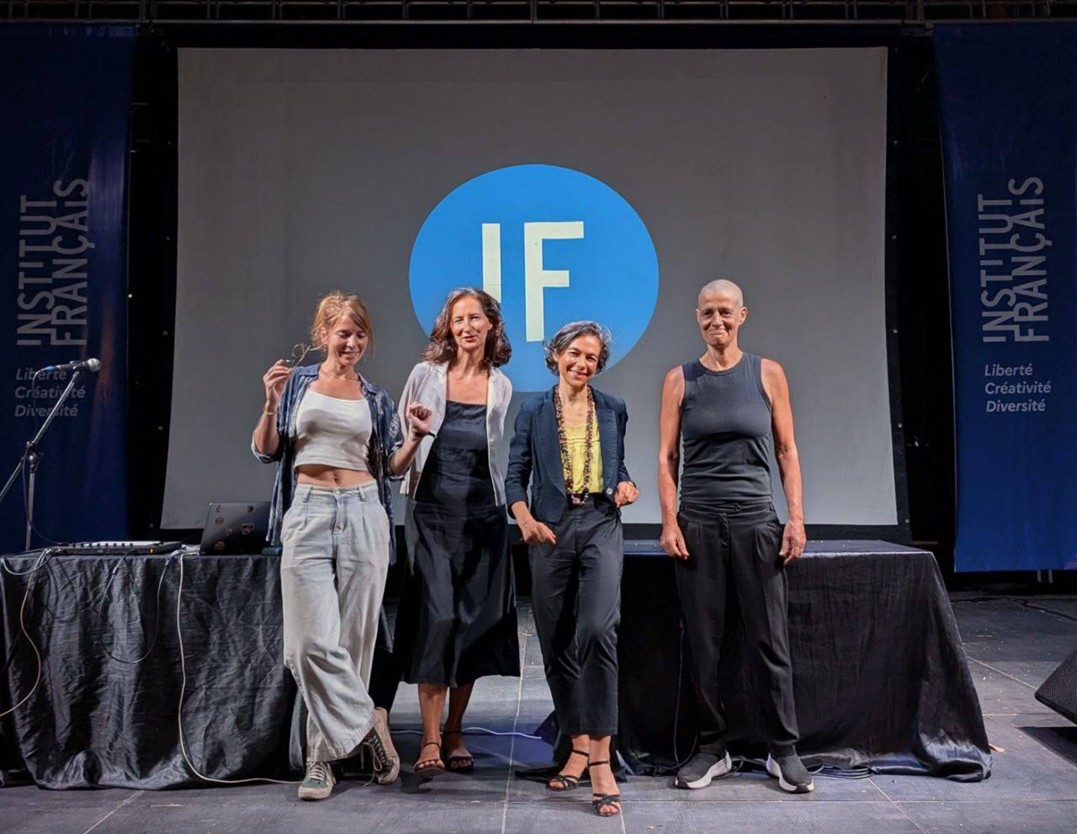
When Marie Buscail, first counsellor and chargée d’affaires a.i. at the French embassy in Cambodia, arrives for our interview, she arrives with a framework. That is, she says with a slight smile, the diplomat in her. Before talking about yoga sessions and DJ sets, she wants to talk about why any of it matters.
“France has been consistently committed to gender equality for decades,” she says. “And that gives us the strength to continue to address these issues and give voice to our rights – even in the face of the current backlash, especially in the field of reproductive rights.”
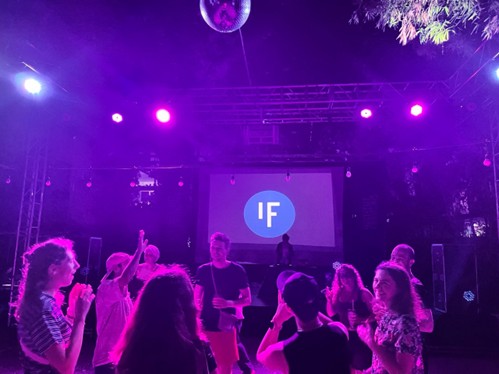
The conversation begins, nominally, around Women in Motion, the programme held on March 5 at the French Institute of Cambodia (IFC) to mark International Women’s Day. But it quickly becomes clear that for Marie, the evening of yoga, experimental sound and electronic music was never just a cultural event. It was one visible expression of something larger: a French diplomatic strategy built around four pillars – education, combating gender-based violence, civic and political participation, and economic empowerment – that France has been developing and deploying internationally for years.
“My Ministry of Foreign Affairs has been driving the deepening of an international strategy for feminist diplomacy,” she explains. “We try to promote these actions in [all of our] relationships.”
Concrete action, not just principle
France backs that commitment not just with words but with money. Through its Feminist Organisations Support Fund, it has directed 300 million euros toward field projects in 75 countries over the past five or six years. These are ground-level interventions – supporting women traumatised by conflict, funding civil society organisations, building infrastructure for change where the need is real.
“It is about having action in the field,” Marie says. “Not only advocating.”
But Marie is equally keen to point to what France is doing here in Cambodia specifically. The embassy applies what she calls a ‘gender marker’ to all of its cooperation projects, ensuring that gender equality is a lens across the board rather than a standalone consideration.
Two examples stand out. The first: a scholarship programme at university level and beyond, with an explicit emphasis on encouraging women into engineering, IT, health and medicine. The results have been encouraging – 53 per cent of participants are currently women, and the embassy is pushing to do better.
The second example is less expected. France has a long-standing commitment to training Cambodian military personnel for UN peacekeeping missions, a programme running for over a decade. One of its strongest draws is French language training, as peacekeeping missions are frequently deployed to French-speaking countries, and Cambodia has built a reputation for sending French-speaking staff. This year, 95 per cent of the graduating class were women.
“I chaired the ceremony marking the end of their three years of training,” Marie says. “I want to stress their commitment. They can be proud.”
The Blue Helmets of the United Nations, it seems, are increasingly worn by Cambodian women.
The body as political space
Which brings us back to March 5, and to the question of why a yoga class, a sound performance and a DJ set belong in the same sentence as feminist diplomacy.
Marie’s answer is more considered than you might expect. The Women in Motion programme, she suggests, was built around a single connective idea: the female body as a site of reflection, autonomy and, at times, contested control.
“The idea is to give space for women to raise the issue of bodies – space, movement, their relationship to their bodies,” she says. “Who has control over your body? Is it you? Is it society? Is it another person?”
The yoga session offered one kind of answer – the practice of getting back to the body on your own terms. The theatre production, Finding Myself (In Mirages), staged the night before by IFC in partnership with Last Stage, went somewhere darker.
“It’s a play that addresses very hard aspects of marginalised women and the sort of disconnection they have between their body and themselves. It is also a way, through cultural diplomacy, to touch upon issues which are difficult to voice within more formal speeches,” she says. “If it is an artist doing a show, then it is sharing an experience – and that is probably the way human beings have always found to discuss the difficult things.”
When asked whether the three Women in Motion artists – yoga instructor Chrystèle Thézé, sound artist Cécile Hinas and DJ Béatrix Moreau, known as Goddamn Kiddo – were in any sense cultural ambassadors for France, Marie pauses.
“In a way, yes,” she says. “But I do not want to attribute to them any political message they have not chosen. What we always want to show, when we do programming at the French Institute, is part of what France is today. It is mirroring the diversity of our society, the questions raised in our society. It is not about bringing answers. It is about bringing questions for discussion.”
“They are not only artists,” Marie continues. “These are multifaceted women who run their business and do art or music. It is also a show of how women have to cope with the economic, material aspect of life, while also trying to elevate themselves, to share a more powerful message … through the stage.”
Culture does what diplomacy cannot
The balance between formal diplomacy and cultural programming – and the particular value of each – is something Marie returns to more than once. The French Institute, she is clear, is not a soft appendage of the embassy. It is a deliberate part of its diplomatic architecture.
“The French Institute complements our action,” she says. “Sometimes you want to present your strategy with clear words and clear objectives. But sometimes – and sometimes more efficiently – you share an experience. You take it from the ground, from something specific, and you present it for collective reflection. We believe strongly in that.”
It is a conviction she holds personally as much as professionally. Before her current posting, Marie was based in Beirut – one of the more complex cultural and political environments imaginable.
“So for me, everything [we’ve talked] about, what culture means for diplomacy, is something I have really experienced. And I am committed to it.”
The new frontier: Online violence
If there is one area where Marie moves beyond the expected talking points, it is technology – specifically the growing threat of online harassment, AI-generated abuse and digital violence aimed at women.
“Another aspect I want to mention, because I think it is particularly relevant for Cambodia,” she says, “is a new tool we have created. We have to face new threats linked to the online dimension – the rise of violence facilitated by technology. This is a serious challenge.”
France, she says, has responded by creating the Laboratory for Women’s Rights Online, described on the embassy website as, “an international platform for collaboration and exchange on gender and digital issues, and in particular on gender-based violence online,” designed to develop practical solutions in a rapidly changing environment.
Asked what meaningful progress looks like in five years, her answer is direct: a safer digital space.
“The AI and digital economy are moving very fast,” she says. “We have to make sure we move as fast as possible to prevent the damage it can bring. Criminality and abuse are always one step ahead. So we have to move just as fast.”
It is, she acknowledges, somewhat ironic coming from someone with no social media presence whatsoever – a detail that emerges almost as an aside. Staying off social media, she notes, has its advantages.
“It preserves us,” she says. “But we have to face the reality that new generations are connected and do not know how to disconnect. This is why we have to protect them.”
A personal reckoning
Near the end of our conversation the diplomatic register drops slightly. Asked what International Women’s Day means to her personally – as a woman, not just as a first counsellor – she takes a moment.
“I would not like to miss it,” she says. “Having this day on the international agenda is already the result of generations of women fighting for their rights. What it represents most for me is keeping the right to claim equality – and not stopping.”
She pauses. “We are at a time when some political tendencies want to shut these voices up. So it is essential that we continue to mark this day.”
France, she is at pains to say, does not approach these conversations from a position of having solved everything. Wage equality has not been achieved at home. Violence against women remains a serious concern. Online abuse is worsening.
“Our approach is a partnership approach,” she says. “I want to extend a hand to all those who want to work together on this. We are not exempt. We all still have progress to make.”
It is that combination – the candour about France’s own unfinished business alongside the conviction that the work must continue – that gives Marie’s diplomacy its particular quality. She is not selling a model; she is looking for allies. And on the evidence of Women in Motion, she is finding them.
