



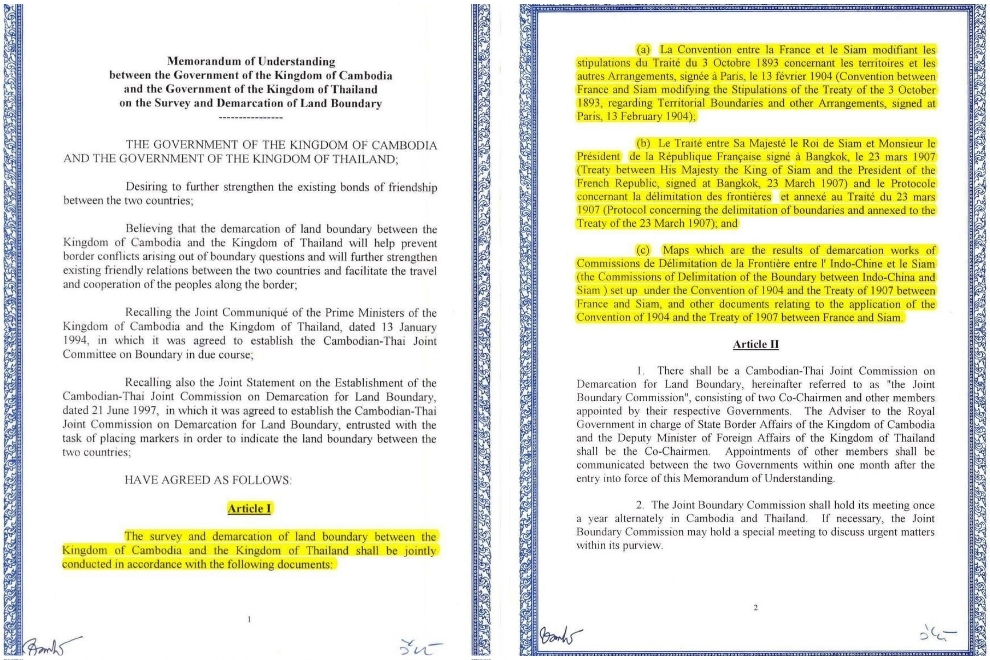
On June 14, 2000, the Royal Government of Cambodia and the Royal Government of Thailand took a significant step toward peace and cooperation by signing the Memorandum of Understanding on the Survey and Demarcation Work of Land Boundary. Far from a vague political gesture, the agreement is an official treaty instrument drafted in three languages, — Khmer, Thai and English — and formally deposited with the Secretariat-General of the UN, making it not only bilaterally binding but internationally recognised.
A Treaty Built on History
The 2000 MoU does not exist in a vacuum. It clearly states that the ongoing survey and demarcation of the Cambodia–Thailand border must be conducted based on existing legal documents and maps—specifically those derived from the Franco–Siamese treaties of 1904 and 1907 and the associated Annex I map series produced by the Franco–Siamese Mixed Commission. These maps, endorsed and used for over a century by both states, leave little room for ambiguity: the temples of Ta Moan Thom, Ta Moan Tauch and Ta Krabei are located well within Cambodian territory.
Legal Clarity, Not Political Convenience
The legal strength of the 2000 MoU lies in its clarity. Article 1 of the MoU explicitly confirms the mutual recognition of the existing legal framework as the baseline for border work. Article 2 further establishes a joint commission responsible for border surveys and demarcation, emphasising cooperation and respect for previously agreed references. Nowhere does it suggest that any unilateral reinterpretation or political manoeuvring can override this legal foundation.
This is crucial when considering recent provocative claims from certain Thai political figures asserting sovereignty over border temples. Such claims not only ignore historical treaties and cartographic facts but also violate the very MoU their own government co-signed.
The UN Treaty Series: Global Witness to Bilateral Commitments
What makes the 2000 MoU even more binding is its registration with the U. According to Article 102 of the UN Charter, treaties registered and published with the UN carry increased international legitimacy and are subject to the scrutiny of international law. This means Thailand cannot feign ignorance or claim that the MoU is outdated — it remains an active, enforceable instrument under international treaty law.
A Commitment Worth Upholding
For Cambodia, the 2000 MoU represents more than just a legal document — it is a pledge to peace, to historical truth and to international order. It acknowledges centuries-old facts, aligns with universally recognised maps, and provides a framework for settling disputes through dialogue and law — not through military provocations or cultural appropriation.
Cambodia has consistently honoured this agreement. We have cooperated through the Joint Boundary Commission, respected legal channels and advocated for peaceful resolution. We expect the same in return.
In the face of misinformation and political posturing, the 2000 MoU stands as a reminder that sovereignty is not up for debate when it has already been settled by law. It is time for all parties to return to the spirit of mutual respect, legality, and cooperation that defined the 2000 agreement.
Cambodia’s territorial integrity is not based on sentiment — it is built on centuries of documented history and codified international treaties. The line has already been drawn — and it is drawn in ink, not in sand.’
Roth Santepheap is a Phnom Penh-based geopolitical analyst. The views and opinions expressed are his own.
