



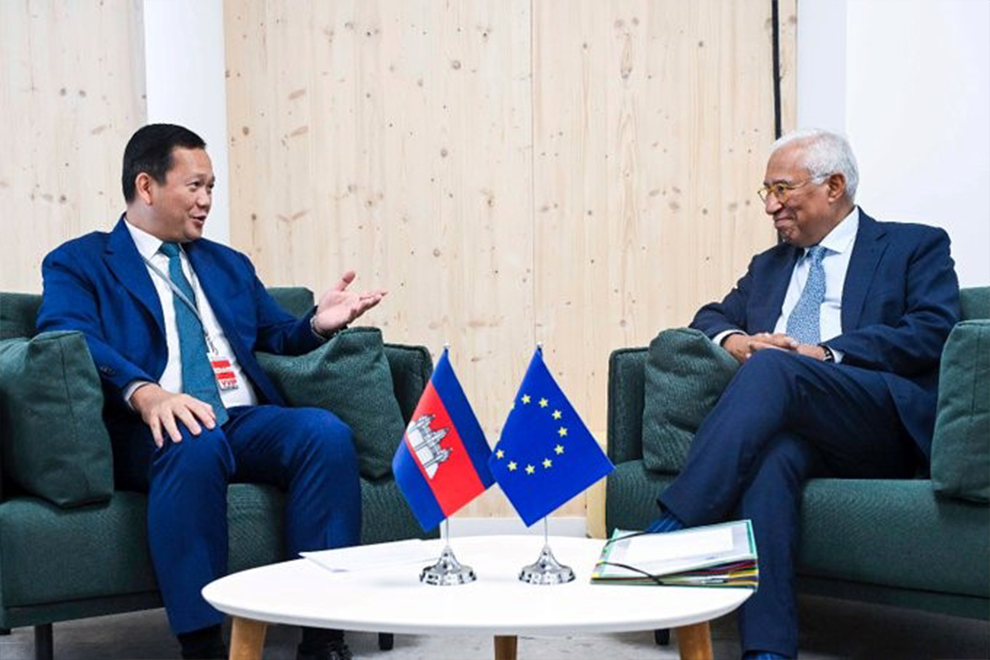
In the picturesque city of Nice, France, a meaningful diplomatic engagement recently unfolded. Cambodian Prime Minister Hun Manet met with two of the most senior figures in the EU: European Council President António Costa and European Commission President Ursula von der Leyen.
The tone of the discussions was friendly yet firm, highlighting both the deepening of cooperation and the continued challenges that lie ahead. President Costa commended Cambodia’s recent reforms and steady economic progress, while expressing the EU’s ongoing interest in human rights and freedom of civil society. Manet, in turn, reaffirmed Cambodia’s readiness to cooperate with all partners while defending its political integrity and social stability.
This exchange serves as a timely reminder that Cambodia-EU relations must now evolve into a phase of mutual understanding. It is not enough for Cambodia to listen to the expectations of the EU; it is equally important for the EU to listen to and appreciate Cambodia’s unique historical context, its social challenges and its political trajectory.
Cambodia’s post-conflict development story is one of the most compelling in modern Southeast Asia. After experiencing the catastrophic Khmer Rouge regime from 1975 to 1979 — during which an estimated two million people perished — Cambodia was left devastated.
Institutions were obliterated, professionals were wiped out and civil society was essentially non-existent. Following a brief Vietnamese-backed government and years of international assistance, Cambodia only held its first free and fair elections in 1993, under the supervision of the UN.
At that time, Cambodia had no real choices. It was a fragile state, dependent on international aid and grappling with disarmament, reconciliation and state-building.
Today, over 30 years later, Cambodia has not only achieved peace and stability but also emerged as one of the fastest-growing economies in the region. It has attracted investment, reduced poverty, expanded education and modernised infrastructure. Now, for the first time in recent history, Cambodia has real choices — not many, but enough to pursue a multi-directional development strategy that engages with all major partners: the EU, the US, China, Japan, South Korea and Australia.
The EU has long positioned itself as a values-based actor, emphasising democracy, human rights and the rule of law in its external relations. These principles are important, and Cambodia is not blind to them. The government has made significant progress in areas such as digital governance, tax reform, education access and civil service modernisation. However, the EU must understand that progress in these areas cannot be judged purely by European standards.
Cambodia is still healing from deep social and generational wounds. It faces structural poverty in rural areas, a relatively young and politically inexperienced population, and a fragile civic culture still adapting to global norms. A sudden shift toward adversarial politics — as some outside actors have encouraged — risks destabilising a system that has only recently found equilibrium.
This is why the EU’s engagement with Cambodia must be guided by a contextual approach, not a conditional one. Calls for more freedom for media and civil society should continue, but they must be pursued through partnership, not pressure — through dialogue, not directives.
Cambodia today is led by a new generation, with Prime Minister Hun Manet symbolising this change. Educated at West Point, with a Master’s Degree from NYU and a PhD from the UK, Manet brings a global outlook combined with strong nationalistic sensibilities. In less than two years in office, he has reinvigorated Cambodia’s diplomacy, spearheaded governance reforms, visited key regional capitals and made the country’s voice heard in important international forums. Manet has been to France twice already.
To have Manet as prime minister is not merely a generational shift — it is a national opportunity. He understands the expectations of international partners, especially those in the West, but he is also deeply committed to ensuring that reforms are rooted in Cambodian realities. He has emphasised that development, unity and peace must go hand-in-hand with democratisation. Such a balanced approach is exactly what Cambodia needs at this critical juncture.
It is therefore in the EU’s best interest to view Manet as a strategic partner — someone who can modernise Cambodia while maintaining stability. Rather than isolating Cambodia when disagreements arise, the EU should seek to engage more deeply, offering support, expertise and trust in return for transparency and reform.
As Cambodia seeks to rebuild trust with its international partners, there is also an appeal to members of the Cambodian opposition living overseas. Cambodia is at a crossroads where internal unity and external respect go hand-in-hand. Opposition members who sincerely love their country should consider contributing in ways that strengthen rather than fracture national development.
Demonstrations and campaigns that portray Cambodia in an exaggeratedly negative light often end up hurting the country more than helping it. These actions can damage investment opportunities, hinder diplomatic progress and create divisions among Cambodians at home and abroad. Constructive patriotism — through civic education, economic participation and cultural engagement — is far more beneficial.
Every Cambodian, regardless of political affiliation, has a role to play in shaping a better future. But this role must be rooted in responsibility, dialogue, and shared commitment to national progress — not in externalised conflict and endless blame games.
Toward a Maturing Cambodia–EU Partnership
Both sides stand to benefit from a renewed and balanced partnership. The EU can leverage its influence to support Cambodia in strengthening the rule of law, enhancing transparency and widening political participation. Cambodia, in return, can benefit from EU investments, technical cooperation, green technology and trade access.
However, this relationship must not be a one-sided lecture. It must be a two-way street, grounded in mutual respect, empathy and patience. Europe must recognise that Cambodia is no longer a country in crisis; it is a country in transition. And transitions take time, especially when building democracy from the ruins of genocide.
Cambodia, too, must keep evolving. Manet has already shown he is willing to listen, learn and lead. His meetings in France were a step toward deeper international engagement — not just with Europe, but with the world.
In short, the spirit of diplomacy lies not only in agreements and handshakes but in understanding. Cambodia has much to gain from its continued partnership with the EU. But for that relationship to thrive, both sides must look beyond headlines and toward shared human and national aspirations. As Cambodia walks forward with new leadership and a forward-looking vision, it calls upon its friends — in Brussels, Paris, Berlin and elsewhere — to walk with it, not ahead of it. And it calls upon its own people, wherever they may be, to put Cambodia’s peace, development and dignity above all else. In the modern world, no country develops alone. And no country should be misunderstood alone. Cambodia deserves to be understood — just as it seeks to understand others.
Seun Sam is a policy analyst at the Royal Academy of Cambodia. The views and opinions expressed in this article are his own.
