



Thailand’s recent behaviour along the Cambodian-Thai border is not just alarming — it is deeply irresponsible. What began as a series of aggressive threats has devolved into a web of contradictions, policy reversals and manipulative tactics that are causing real harm to thousands of people. At the heart of this crisis lies not a conflict with Cambodia, but Thailand’s own internal dysfunction and the absence of unified, accountable leadership.
In recent weeks, Thai authorities have issued repeated threats: To cut electricity and internet connections to Cambodian areas, to ban fuel imports and to shut down border checkpoints.
These declarations were made publicly, loudly and without ambiguity. But when Cambodia responded appropriately — with countermeasures and calls for clarification — Thailand abruptly shifted its narrative, claiming it had no intention of carrying out the threats it had clearly articulated.
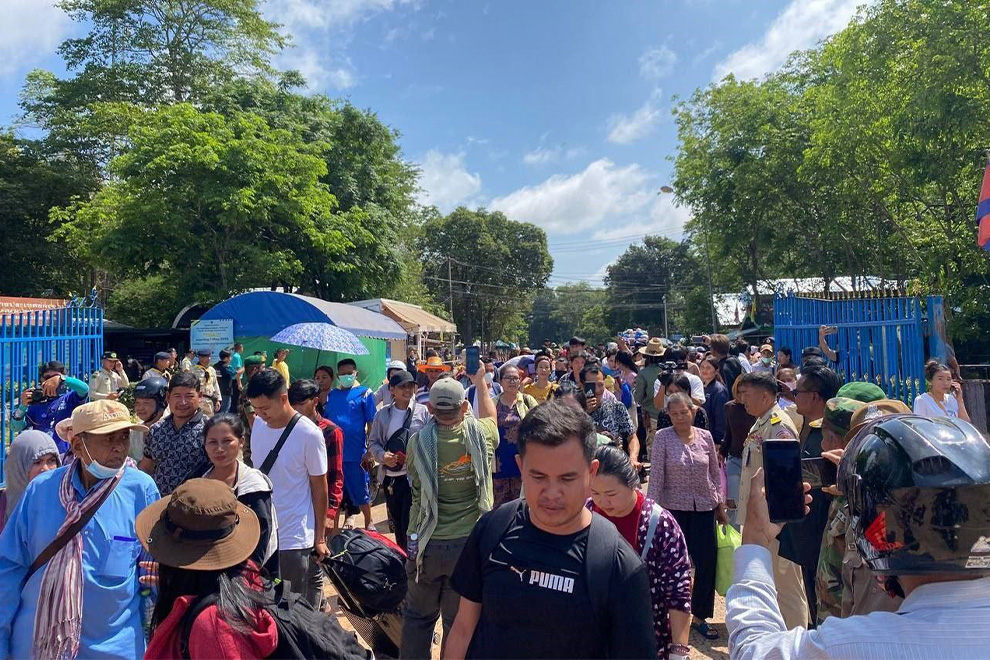
In yet another confusing turn, Thai officials then announced that border checkpoints had been reopened. But on the ground, the reality tells a different story. While crossings may be “open” in name, they remain functionally closed. People and goods are still blocked, commerce is at a standstill, and families remain separated. These contradictory actions have made a mockery of official statements and fuelled deep uncertainty.
This raises a fundamental question: What exactly is happening in Thailand?
There are two plausible explanations, and neither reflects well on the Thai state. One is that there is a serious breakdown between the country’s civilian government and its military, with each issuing conflicting messages and pursuing different agendas. The other, more troubling possibility is that these inconsistencies are deliberate — part of a calculated attempt to confuse the public, deflect responsibility and shift blame onto Cambodia.
If the issue is internal power struggle, it signals a government unable to coordinate even its most basic functions. If it is instead a campaign of deception, then it is nothing short of unethical. Either way, it is the people — Cambodian and Thai alike — especially those in vulnerable border communities, who are paying the price.
Communities on both sides of the border depend on daily cross-border trade. Fuel, food, medicine and other essentials flow through these checkpoints. Sudden closures and erratic policies disrupt lives instantly. Children are unable to attend school. Small businesses lose income. Hospitals face supply shortages. Families with members on both sides are thrown into confusion and fear.
Even more damaging is the deliberate ambiguity. Thailand’s shifting posture — threatening one day, denying the next — is not only irresponsible; it is deeply manipulative. These tactics manufacture instability. And when Cambodia responds to protect its interests and its people, Thailand accuses it of overreacting. But there is no overreaction in asking a neighbour to act with consistency and responsibility.
To be clear: Cambodia has done nothing to provoke this situation. Its responses have been measured and rational. Its demands — for transparency, stability and respect — are entirely justified. Yet Thailand has attempted to cast Cambodia as the aggressor, a claim that crumbles under the most basic scrutiny.
What we are witnessing is a troubling pattern. Thailand appears to be using confusion as a tool — to mislead its own citizens and misrepresent its actions to the international community. The objective seems clear: to distract from its own internal disorder by inventing an external problem. But in doing so, it is not just damaging its relationship with Cambodia — it is undermining its own credibility.
This is no longer simply a border issue. It is a test of state responsibility. No responsible government threatens essential services, lies about its intentions, or plays political games with the lives of its own citizens and those of neighbouring countries.
The international community is watching. These actions — no matter how many times they are denied, rebranded or buried under new statements — leave a clear record. And that record will speak for itself. The truth always emerges. When it does, Thailand will be held accountable for its choices.
Cambodia calls on Thailand to bring an immediate end to these disruptive and misleading tactics. The cycle of threats, denials and contradictory actions must stop. It is time for Thailand to take full responsibility, acknowledge the harm caused to border communities and take tangible steps to fix it. That begins with restoring full, functional operation of all border checkpoints — and ensuring the free, safe flow of people and goods, as any responsible neighbour would.
Inconsistency is not a strategy — it is a failure. And it is not Cambodia that will bear the cost of that failure, but Thailand, unless it changes course now.
Let this be a turning point. The people living along the border deserve better — stability, clarity and respect. They deserve not to be pawns in a power struggle or victims of incoherent leadership. It is time for Thailand to act as the responsible partner it claims to be — and for its leaders, civilian and military alike, to speak and act with one voice rooted in honesty, integrity and accountability.
Khemrak Rath is a Phnom Penh-based geopolitical analyst. The views and opinions expressed are his own.
